








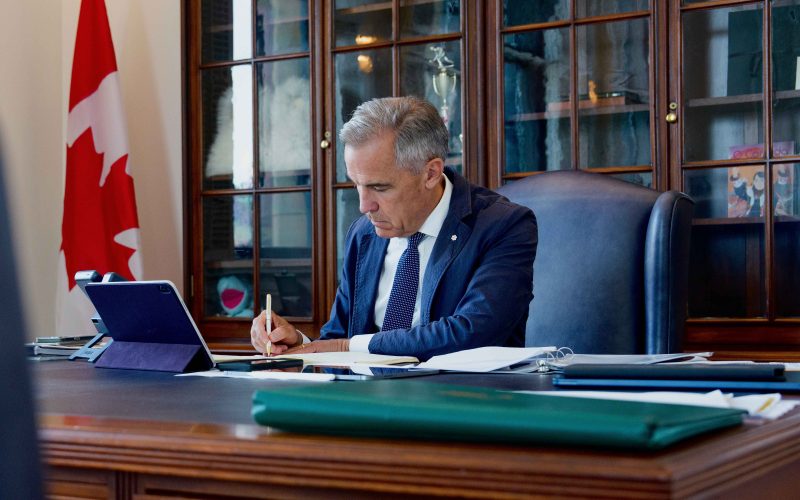
Canadian Prime Minister Mark Carney has paused a key electric vehicle (EV) sales requirement while advancing a “Buy Canadian” procurement drive, as his government responds to the economic fallout from US trade measures.
Automakers will no longer be required to ensure that 20% of new vehicle sales are electric by next year, Carney said. The government will also prioritise Canadian-made goods in federal contracts and establish a fund to help firms develop new products.
The announcement comes amid signs of economic strain. Canada shed 66,000 jobs in August, largely due to a fall in part-time work, pushing unemployment up to 7.1%—its highest level since 2016, excluding the pandemic years.
“We cannot control what other nations do,” Carney said. “We can control what we give ourselves—what we build for ourselves.”
While the 2026 EV mandate has been paused, the government said longer-term targets would remain unchanged: 60% of new vehicle sales by 2030 and 100% by 2035. Ottawa will also launch a 60-day review of the EV rules.
The original mandate was introduced in 2023 under former prime minister Justin Trudeau. Government data show zero-emission vehicles accounted for 11.7% of new car sales last year.
Opposition leader Pierre Poilievre criticised the move, accusing Carney of reversing course on his earlier support for phasing out petrol and diesel vehicles by 2030. He said the delay created uncertainty for investors in Canada’s auto sector.
“So now, businesses who would otherwise consider investing in auto manufacturing here in Canada would have to put that investment on hold while Mark Carney dithers for another year,” Poilievre said.
The policy shift comes as the United States, under President Donald Trump, has imposed 25% tariffs on foreign vehicles, with limited exemptions for manufacturers in Canada and Mexico, alongside a blanket 35% tariff on Canadian goods. While most products remain tariff-free under the Canada–United States–Mexico Agreement, sectors including autos, steel and aluminium have been hit.
Ottawa recently rolled back some retaliatory tariffs to revive trade talks with Washington. Carney said he had held “good conversations” with Trump this week and was seeking relief for affected industries.
The government also announced support for canola farmers after China imposed preliminary duties of 75.8% on seed imports last month—widely seen as retaliation for Canada’s 100% tariffs on Chinese EVs introduced in October 2024.