






DHL Group has strengthened its sustainability efforts across Asia Pacific, advancing its decarbonisation roadmap in 2025 to meet rising demand for emissions-reduced logistics solutions.
The group said progress was driven by a combination of sustainable fuel agreements, fleet electrification and the rollout of carbon-neutral facilities across the region.
Ken Lee, CEO, Asia Pacific, DHL Express, said: “Sustainability isn’t just a slogan for us. We lead with action to reduce greenhouse gas emissions from our operations, and together with the right partners, we are setting a benchmark for the logistics industry.”
In aviation, DHL Express continued to scale sustainable aviation fuel (SAF) use as it works towards a target of 30% SAF adoption by 2030. In 2025, the company signed new SAF agreements with Cosmo Energy, Cathay and Neste, securing close to 20 million litres of SAF for flights departing Narita, Incheon and Singapore. DHL Express is now among the leading SAF users in the logistics sector.
Customer uptake of SAF also increased through DHL’s GoGreen Plus service, with more than 153,000 customers in Asia Pacific using the offering in 2025 to reduce Scope 3 emissions from international air shipments via a book-and-claim model.
Niki Frank, CEO, Asia Pacific, DHL Global Forwarding, said: “Customers are increasingly asking for solutions that help them decarbonise entire supply chains. With our reach across air, ocean and road freight, DHL is uniquely positioned to deliver those ambitions through collaboration and innovation.”
In ocean freight, DHL Global Forwarding partnered with CMA CGM to purchase 8,800 metric tonnes of second-generation biofuel, targeting emissions reductions of around 25,000 metric tonnes on a well-to-wake basis.
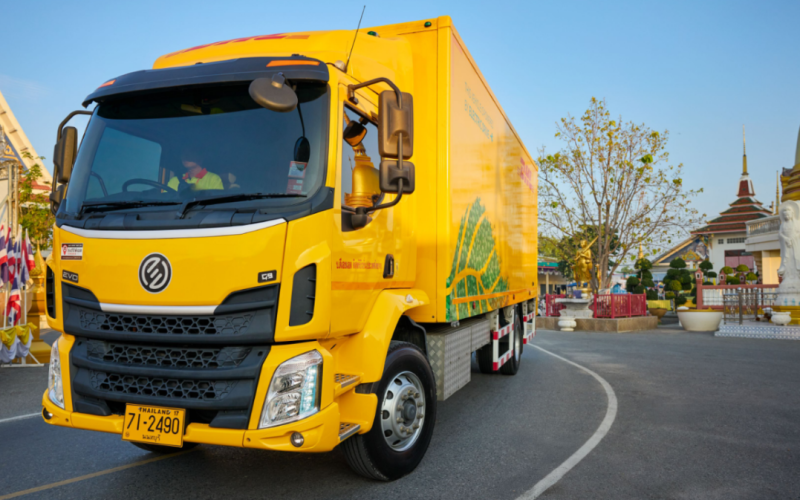
On land, DHL expanded the deployment of low-emissions vehicles. Hydrogen-powered trucks were introduced for long-haul operations in Japan, while electric vehicle (EV) fleets were rolled out across Thailand, the Philippines, Korea and China. DHL Group now operates more than 1,800 EVs in Asia Pacific, supporting its goal of electrifying two-thirds of its last-mile fleet by 2030.
Javier Bilbao, CEO, Asia Pacific, DHL Supply Chain, said: “When it comes to sustainability, we don’t wait for mandates. Our carbon-neutral facilities and electric vehicle deployments reflect a long-term vision to reimagine logistics for a low-carbon world.”
The company also invested in low-carbon infrastructure. In Thailand, DHL Supply Chain opened its first fully renewable-energy warehouse globally, powered entirely by on-site solar generation and battery storage. New DHL Express facilities in Thailand and the Philippines were also designed to reduce energy consumption.
DHL said the initiatives underscore its ambition to reach net-zero emissions by 2050, while supporting customers’ decarbonisation goals and signalling growing demand for low-carbon logistics solutions across the region.