






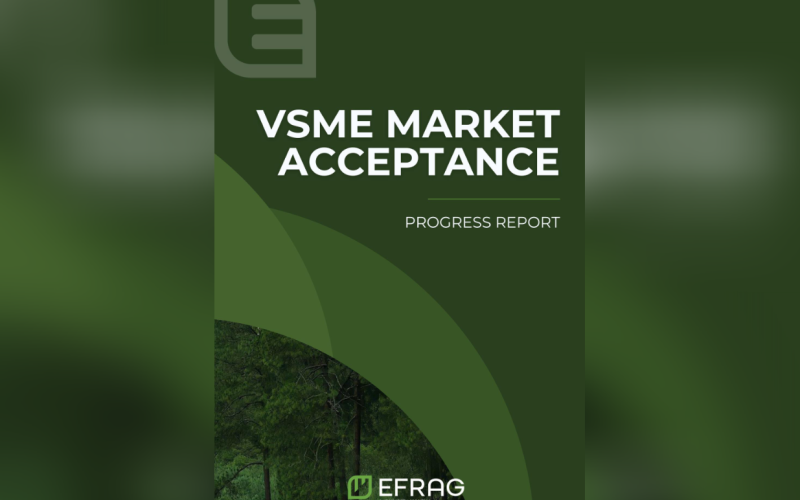
EFRAG has published a new progress report examining early market feedback on the Voluntary Sustainability Reporting Standard for SMEs (VSME), highlighting growing awareness, practical use cases and remaining barriers to adoption across Europe.
The report draws on findings from EFRAG’s VSME Market Acceptance Survey, conducted as part of its broader VSME Ecosystem work following the European Commission’s adoption of the VSME Recommendation on 30 July 2025. The survey assessed awareness, usage and acceptance of the VSME as a voluntary sustainability reporting tool among small and medium-sized enterprises, as well as key users including financial institutions, business partners and value-chain actors.
According to the report, awareness of the VSME Standard is increasing, with generally positive market acceptance. Many respondents reported using the VSME as a guiding framework for collecting and structuring sustainability information, even where full implementation has not yet taken place.
SMEs participating in the survey cited several benefits from using the VSME, including improved access to finance, cost optimisation and strategic advantages linked to clearer sustainability data. However, the report also identifies challenges that could slow wider uptake, such as limited training, unclear methodologies and a lack of supporting tools. Respondents also pointed to the absence of a centralised digital repository as a constraint on the usability and comparability of reported data.
The survey highlights strong demand for additional guidance, particularly on specific disclosures and sector-specific topics. Stakeholders also called for greater awareness-raising initiatives, including examples of completed VSME reports, training sessions and collections of best practices. Interest was expressed in free and accessible reporting tools, as well as a potential certification mechanism to confirm VSME completion.
Digital solutions emerged as a key enabler for broader adoption. The report underscores the importance of continued development of the VSME Digital Template, alongside a more comprehensive set of greenhouse gas calculators and the identification of tools covering water stress, biodiversity and geolocation.
Based on the findings, the EFRAG Secretariat said it will consider developing further practical guidance on specific disclosures, and potentially sector-specific guidance, as well as compiling examples of completed VSME reports to capture best practices. EFRAG also plans to continue work on digital tools and reassess market progress through a second VSME Market Acceptance Survey in 2026.