







Europe’s proposed “biofuels loophole” in the 2035 zero-emission cars law could trigger an unsustainable surge in demand for scarce waste-based biofuels, according to new analysis by Transport & Environment (T&E).
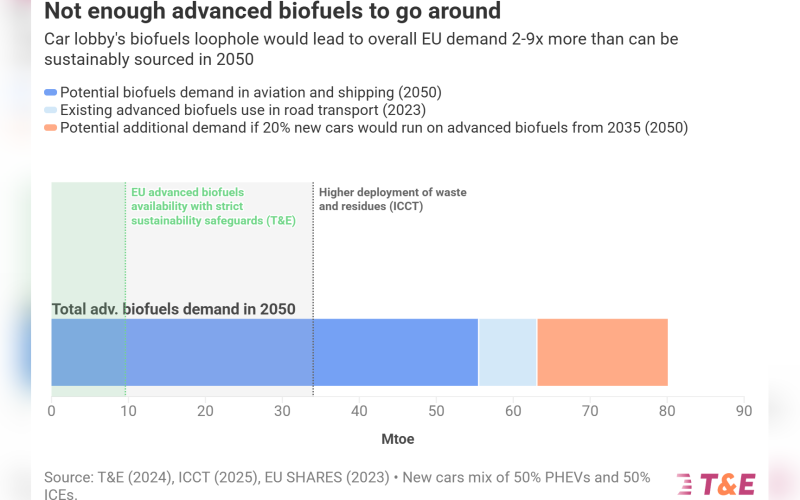
T&E’s modelling suggests that allowing new combustion-engine vehicles running on biofuels to be sold after 2035 would drive up demand for waste feedstocks such as animal fats, used cooking oil and palm oil by-products far beyond sustainable limits. A single car powered by animal fats would require the annual equivalent of around 120 pigs, the report finds. Overall, cars, ships and planes could end up consuming between two and nine times more advanced biofuels than Europe can sustainably supply.
The EU is under mounting pressure from parts of the fuels and automotive industries — backed by the Italian government — to permit new internal combustion engines fuelled by biofuels beyond the 2035 deadline. Critics warn this would divert limited advanced biofuels away from hard-to-decarbonise sectors such as aviation and shipping, which already face a substantial supply shortfall. Under current EU targets, demand from planes and ships alone is projected to require roughly twice the sustainably available advanced biofuel supply in 2050, even under the most optimistic scenarios.
Lucien Mathieu, cars director at T&E, said: “The push for biofuels is absurd. Europeans can’t eat enough pork or fries to sustainably run even a fraction of Europe’s cars, let alone its ships and planes. Why are the car and oil lobbies flogging non-solutions when we have a ready technology in electric cars? This is nothing but a delay tactic that will leave Europe uncompetitive in the global EV market.”
T&E warns that advanced biofuels — particularly waste-based fuels — are not scalable. Europe already imports over 80% of its used cooking oil from countries including China and Malaysia. Demand for animal fats is similarly immense: European cars consume around 1.3 million tonnes annually, the equivalent of about 200 million slaughtered pigs. Meanwhile, a car fuelled by used cooking oil would require the equivalent of 25 kg of fries per day.
The widening gap between demand and sustainable supply is likely to deepen Europe’s reliance on imports. T&E estimates that around 60% of Europe’s biofuels — both crop-based and advanced — already come from outside the EU. If a biofuels loophole is introduced, this share could rise to 90% by 2050. Such dependence, the group warns, also heightens the risk of fraud, with virgin palm oil and other edible oils potentially being mislabelled as waste. Previous T&E investigations have found major discrepancies in imported volumes of used cooking oil and palm oil mill effluent, far exceeding what can be collected in exporting countries.
In a coordinated push last week, German car lobby VDA, automotive supplier group CLEPA and 28 fuel companies urged the European Commission to consider vehicles running on biofuels as “zero-emission” after 2035. The European carmakers’ association ACEA has likewise called for a “pragmatic implementation” of rules that would permit new cars powered by so-called carbon-neutral fuels to be registered beyond the cut-off date.