







At a time when the costs of climate inaction are becoming impossible to ignore, the European Union and India have anchored sustainability and climate resilience at the centre of a landmark new trade partnership. The newly concluded EU–India Free Trade Agreement (FTA) places sustainability, climate action, labour rights and inclusive growth at the heart of one of the world’s largest bilateral economic partnerships—signalling a deliberate shift in how major economies approach trade in an era of planetary stress.
Rather than treating environmental and social considerations as an annexure or an afterthought, the FTA embeds them directly into its legal and institutional architecture. Dedicated chapters on Sustainable Food Systems and Trade and Sustainable Development (TSD) position climate resilience, environmental protection and social safeguards as core objectives alongside market access. In doing so, the agreement reflects a shared recognition that economic integration cannot be separated from the ecological and social systems on which it depends.
Against a backdrop of geopolitical uncertainty, fragmented supply chains and declining trust in multilateralism, the EU–India FTA also signals strategic convergence between the world’s two largest democracies—anchored in rules-based trade, sustainability and inclusive development.
Trade with a broader purpose
What distinguishes the EU–India FTA from earlier trade agreements is its explicit effort to redefine the purpose of trade itself. Sustainability is not framed as an aspirational add-on but as a binding component of economic cooperation.
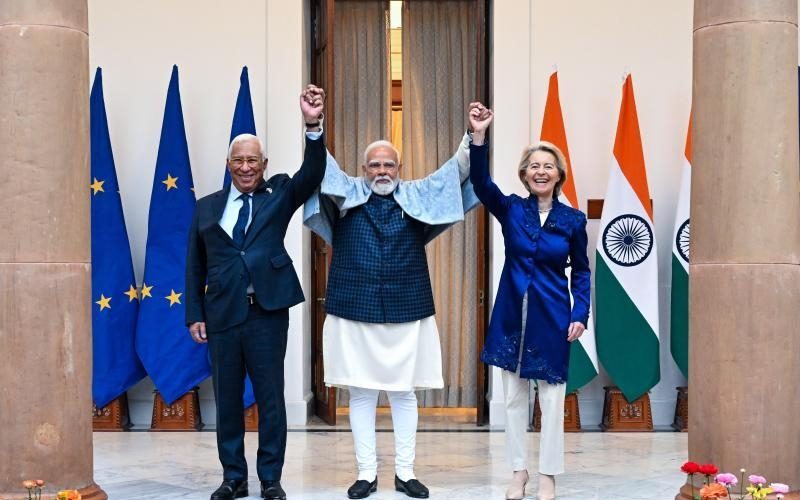
Speaking at the signing, India’s Prime Minister Narendra Modi described the agreement as a “new blueprint for shared prosperity”, framing EU–India cooperation as a partnership for global good which will further strengthen sustainable agriculture, clean energy and women empowerment.
He said, “Together we will establish the India-Middle East-Europe Economy Corridor (IMEC) as a major link for global trade and sustainable development.”
President of the European Council, Antonio Costa said, “As the two largest democracies in the world, we are working hand in hand to deliver concrete benefits for our citizens and to shape resilient global order that ends up in peace and stability, economic growth and sustainable development. I am proud of the commitments we are making for greater cooperation on clean energy, green transition and climate resilience.”
Trade and sustainable development: binding commitments, not soft language
At the heart of the agreement lies the Trade and Sustainable Development chapter, which sets out a comprehensive and legally binding framework covering environmental protection, climate action, labour standards and gender equality.
Crucially, the chapter safeguards each party’s right to regulate and explicitly prevents either side from weakening, waiving or failing to enforce environmental or labour laws to attract trade or investment. This addresses long-standing concerns that free trade agreements can trigger a regulatory “race to the bottom”.
The TSD chapter commits both parties to:
- Enhance environmental protection and address climate change
- Protect workers’ rights and promote decent working conditions
- Support gender equality and women’s economic empowerment
- Create structured platforms for dialogue on trade-related environmental and climate issues
- Ensure effective implementation through enforceable mechanisms
Civil society organisations are also granted an active role in monitoring implementation—an acknowledgement that accountability cannot rest solely with governments.
Climate action and global environmental governance
The EU–India FTA explicitly aligns trade cooperation with global environmental commitments. Both sides reaffirm their obligations under key Multilateral Environmental Agreements, including the Paris Agreement, the Convention on Biological Diversity and the Convention on International Trade in Endangered Species of Wild Fauna and Flora.
Beyond reaffirmation, the agreement commits the EU and India to practical cooperation on climate-related issues such as renewable energy deployment, emissions reduction in the maritime sector, sustainable forest management and the protection of marine ecosystems. It also promotes collaboration to accelerate the transition towards a circular and resource-efficient economy.
Dedicated provisions address the protection and management of natural resources, with commitments covering forest conservation, biodiversity protection, the fight against illegal wildlife trade and logging, and action against illegal, unreported and unregulated fishing.
Through improved market access, the deal aims to make trade and investment in low-carbon goods, services and technologies easier. Reduced tariffs on green goods and the liberalisation of services relevant to the green transition are intended to accelerate the diffusion of technologies that mitigate climate change and reduce environmental harm across air, water and soil.
Carbon, competitiveness and CBAM cooperation
One of the most closely watched elements of the agreement is its engagement with the EU’s Carbon Border Adjustment Mechanism (CBAM). The FTA secures forward-looking commitments, including most-favoured-nation assurances should flexibilities be granted to third countries, enhanced technical cooperation on carbon pricing recognition, recognition of verifiers and targeted financial assistance to support emissions reductions.
For Indian industry, these provisions are designed to ease the transition towards emerging carbon requirements while preserving export competitiveness—an issue of growing importance as climate-linked trade measures expand globally.
Labour rights, gender equality and inclusive growth
The agreement embeds respect for core labour standards, requiring adherence to the principles of the International Labour Organization. These include freedom of association, the right to collective bargaining, the elimination of forced and child labour, non-discrimination at work and the right to a safe and healthy working environment.
Beyond minimum standards, the TSD chapter promotes cooperation on labour inspection, social dialogue and responsible business conduct—reflecting an understanding that sustainable trade depends on institutional capacity, not just legal commitments.
Gender equality is addressed through provisions aligned with relevant UN and ILO conventions, supporting women’s economic empowerment and promoting cooperation in international fora. In doing so, the agreement acknowledges that trade outcomes are not gender-neutral and that inclusive growth requires deliberate policy design.
From negotiation fatigue to strategic convergence
EU–India FTA negotiations were first launched in 2007, suspended in 2013 amid unresolved differences, and relaunched in 2022 against a dramatically altered global backdrop. The final negotiating round concluded in October 2025, followed by intensive technical and political discussions that ultimately delivered consensus.
That the agreement has emerged now—amid rising geopolitical tensions, climate emergencies and economic fragmentation—highlights its strategic significance. It signals a shared belief that openness, sustainability and cooperation are not competing objectives but mutually reinforcing ones.
A deal of significant—but not singular—economic scale
The economic dimensions of the agreement remain substantial. Once fully implemented, it is expected to grant preferential access for over 99% of Indian exports to the EU, while EU goods exports to India are projected to double by 2032. Tariff reductions are set to cover 96.6% of EU goods exports, with estimated annual duty savings of around €4 billion, while Indian exports worth roughly $75 billion are expected to benefit from improved market access.
These figures underline the agreement’s scale—but they are best understood as enabling conditions rather than the defining purpose of the deal.
A trade agreement for a changing world
The EU–India Free Trade Agreement is not merely about lowering tariffs or expanding export volumes. It reflects an evolving vision of trade itself—one that integrates climate resilience, social justice and long-term economic transformation into the core of bilateral cooperation.
Whether the agreement delivers fully on its promise will depend on implementation, enforcement and continued political will. But as a framework, it marks a decisive step towards aligning global trade with the realities of climate change, inequality and technological disruption.
In that sense, the EU–India FTA is less a conclusion than a beginning: a test case for how two major economies can use trade as a tool not only for growth, but for shared prosperity and sustainable development in an increasingly uncertain world.