








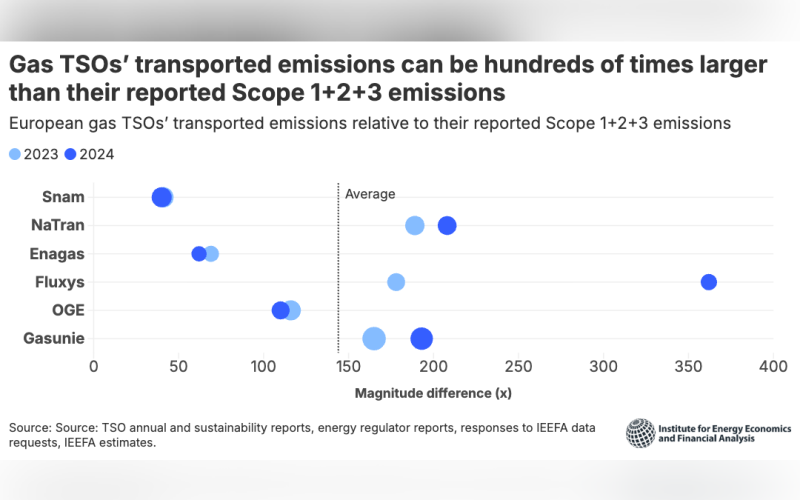
European gas pipeline operators report, on average, less than 1% of their total emissions due to a climate accounting loophole that allows them to exclude emissions from the final use of the gas they transport, according to new research from the Institute for Energy Economics and Financial Analysis (IEEFA).
The analysis finds that limited guidance from the Greenhouse Gas Protocol enables transmission system operators (TSOs) to omit so-called “transported emissions” from their disclosures. As a result, investors may gain the misleading impression that gas pipeline companies are low-carbon businesses, despite their central role as the midstream link in the fossil fuel value chain.
IEEFA warns that the gap creates risks of greenwashing and leaves significant climate-related risks unpriced for financial institutions providing capital to the sector. Arjun Flora, energy finance analyst at IEEFA and author of the report, said the loophole distorts markets by allowing capital to flow to gas infrastructure that might otherwise be directed towards lower-carbon investments.
The report examines six European gas pipeline companies — Enagás, Fluxys, Gasunie, NaTran, Open Grid Europe and Snam — none of which currently report transported emissions. Together, they own and operate more than 100,000 kilometres of gas pipelines and over half of the EU’s liquefied natural gas terminals.
IEEFA estimates the companies’ combined transported emissions at around 700 million tonnes of carbon dioxide annually, comparable to the total greenhouse gas emissions of Germany. On average, these transported emissions are around 150 times higher than the emissions currently reported by the companies.
The operators argue that they do not own or sell the gas they transport, and therefore should not be required to disclose downstream emissions. However, Flora said this position contradicts their portrayal as energy transition partners promoting low-carbon gas networks, noting that the companies play an active role in shaping European energy policy.
The report also highlights insufficient pressure from regulators and investors, partly due to inconsistent guidance from the Greenhouse Gas Protocol and delays in finalising sector-specific European Sustainability Reporting Standards.
IEEFA said closing the transported emissions loophole would improve transparency and add credibility to gas pipeline operators’ transition strategies, financing frameworks and long-term business plans as Europe moves towards a lower-carbon energy system.