






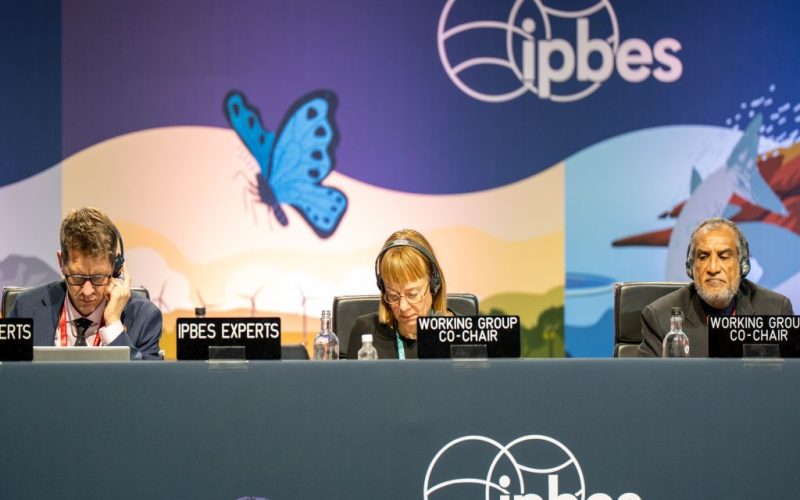
A new report by the Intergovernmental Platform on Biodiversity and Ecosystem Services (IPBES) has warned that biodiversity loss now poses a critical systemic risk to the global economy, financial stability and human wellbeing.
The IPBES Methodological Assessment Report on the Impact and Dependence of Business on Biodiversity and Nature’s Contributions to People, approved by more than 150 governments during the 12th IPBES Plenary in Manchester, finds that all businesses depend on biodiversity and all businesses contribute to its decline, often without bearing the financial costs of negative impacts.
Prepared over three years by 79 experts from 35 countries, the report concludes that businesses are central to halting and reversing biodiversity loss but frequently lack the data, incentives and institutional support to manage their impacts and dependencies effectively.
“This is a pivotal moment for businesses and financial institutions,” said Matt Jones, Co-chair of the Assessment. “Businesses and other key actors can either lead the way towards a more sustainable global economy or ultimately risk extinction… both of species in nature, but potentially also their own.”
The report highlights that $7.3 trillion in global public and private finance flows in 2023 had directly negative impacts on nature, including $4.9 trillion in private finance and $2.4 trillion in environmentally harmful public subsidies. By contrast, only $220 billion—around 3% of harmful public incentives—was directed towards biodiversity conservation and restoration.
“The loss of biodiversity is among the most serious threats to business,” said Prof. Stephen Polasky, Co-chair of the Assessment. “Yet the twisted reality is that it often seems more profitable to businesses to degrade biodiversity than to protect it.”
The report also finds that fewer than 1% of publicly reporting companies disclose biodiversity impacts, while a survey of financial institutions representing 30% of global market capitalisation identified lack of reliable data, models and scenarios as the main barriers to nature-related risk management.
The authors stress that no single method is sufficient to measure biodiversity impacts, recommending a mix of site-level and portfolio-level approaches, and greater integration of scientific, Indigenous and local knowledge.
“Better engagement with nature is not optional for business – it is a necessity,” said Prof. Ximena Rueda, Co-chair of the Assessment, adding that transparent disclosure of impacts, dependencies and lobbying activities is essential to avoid greenwashing.
The report identifies more than 100 concrete actions for businesses, governments, financial actors and civil society to create an enabling environment for biodiversity protection, spanning policy, finance, technology, data and institutional capacity.
“This is not some distant environmental issue,” said Prof. Polasky. “Better stewardship of biodiversity is central to managing risk across the whole of the economy.”
IPBES Chair Dr David Obura said the report provides urgent guidance to support delivery of the Global Biodiversity Framework, Sustainable Development Goals and the Paris Agreement, while IPBES Executive Secretary Dr Luthando Dziba said it offers “much-needed clarity and coherence to guide actions by business and all decision-makers.”