








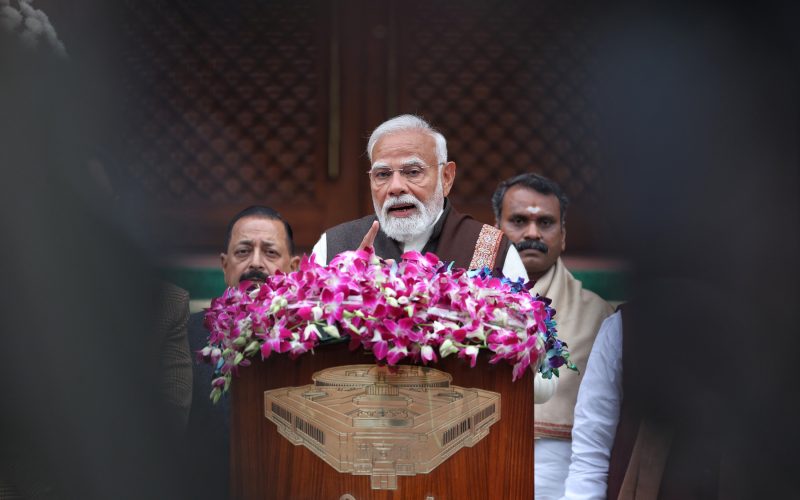
India is embedding climate action into its development model through a whole-of-economy strategy that integrates adaptation, mitigation and behavioural change, according to the Economic Survey 2025–26 tabled in Parliament.
The Survey says the global climate agenda has reached an inflexion point, with the transition to net zero increasingly shaped by trade-offs, capacity constraints and a widening gap between ambition and delivery. It cautions that rapid adoption of complex climate systems without adequate buffers, institutional capacity and redundancy can undermine resilience. Instead, it argues that climate policy must prioritise human welfare, particularly for poorer and climate-vulnerable populations, and positions development itself as a core form of adaptation.
Adaptation is therefore placed at the centre of India’s climate strategy. The Survey notes that India’s adaptation and resilience-related domestic spending increased from 3.7% of GDP in FY2016 to 5.6% in FY2022, reflecting a development-led approach that channels public investment into critical sectors. Climate action is guided by the National Action Plan on Climate Change, which comprises nine missions, many with a strong focus on adaptation, including sustainable agriculture, water conservation and integrated resource management. At the sub-national level, State Action Plans on Climate Change translate national priorities into sector-specific and locally tailored interventions.
With urbanisation accelerating, the Survey underscores the importance of embedding climate risk into urban planning, land use, infrastructure design and service delivery to strengthen long-term resilience in cities.
On mitigation, India is pursuing a diversified energy transition that balances decarbonisation with energy security and affordability. The Survey highlights international experience, including in parts of Europe, to warn against transitions that outpace investments in baseload generation, transmission networks and system flexibility. It frames the coming decade not as a narrow climate policy challenge, but as a broader energy system transformation.
India has already exceeded its target of achieving 50% installed power capacity from non-fossil fuel sources, reaching 51.93% by the end of December 2025. This progress has been supported by record renewable energy additions and complemented by initiatives such as the National Nuclear Mission, the Green Hydrogen Mission and the Bio Energy Programme. However, the Survey flags material availability and energy storage as key constraints to deeper integration of clean energy.
The Survey identifies critical minerals as a growing strategic bottleneck in the global energy transition, noting that access to lithium, cobalt, nickel, copper and rare earth elements is increasingly shaping the low-carbon economy. India’s response combines domestic capability-building under the National Critical Mineral Mission with international partnerships, including lithium mining assets in Argentina and collaborations in Australia and Chile.
Beyond energy and resources, the Survey tracks progress on structural reforms, including the enactment of the SHANTI Act in December 2025, which opens nuclear power generation, manufacturing and research to private sector participation. It also highlights the rollout of the Carbon Credit Trading Scheme, which blends mandatory compliance with voluntary offsets, and Mission LiFE, which embeds behavioural change into India’s climate framework by reshaping consumption patterns and social norms.
On climate finance, the Survey highlights a persistent global funding gap of around USD 4 trillion, with developing countries disproportionately affected. In India, climate finance remains largely domestically sourced and concentrated in mature sectors such as solar and wind, while adaptation, urban infrastructure, MSMEs and hard-to-abate industries remain underfunded. To scale investment, the government is strengthening development finance institutions, deepening green and municipal bond markets, and calling for reforms in multilateral development banks to mobilise private capital more effectively for climate action in the Global South.

