









Rainforest Builder, a fully integrated tropical forest restoration company operating across West Africa, has signed a long-term carbon removal offtake agreement with Microsoft for its ecosystem restoration initiative in Sierra Leone, known as Project Buffalo.
Under the agreement, Rainforest Builder will supply up to 1.8 million carbon removal credits over 15 years, making it one of the largest carbon removal offtake agreements linked to a single African project announced to date. The deal is seen as a significant milestone for both the development of Africa’s voluntary carbon markets and efforts to restore the region’s critically degraded Upper Guinean Forest.
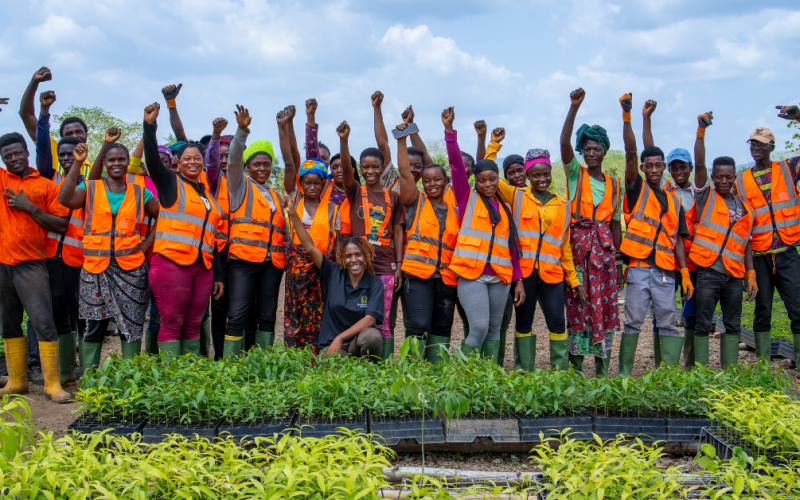
The Upper Guinean Forest, once one of the most biodiverse tropical ecosystems in the world, has lost more than 90% of its original forest cover due to decades of deforestation. To help reverse this trend, Rainforest Builder’s team in Sierra Leone has planted more than 1.8 million trees since 2023, with plans to plant over 10 million trees across 15,000 hectares of degraded community land as the project expands.
The region hosts the highest number of mammal species among the world’s biodiversity hotspots and is home to numerous endemic and threatened species. However, much of this wildlife now survives only in small fragments of old-growth forest that together account for less than 1% of Sierra Leone’s land area. Project Buffalo aims to restore habitat connectivity and biodiversity while increasing forest biomass and long-term ecosystem resilience.
Beyond environmental restoration, the initiative is expected to generate significant socio-economic benefits for rural communities. In 2025, the project directly employed around 1,200 people, with employment expected to rise as restoration activities expand. Rainforest Builder has also introduced a benefit-sharing programme that includes support for smallholder agriculture, local road infrastructure and a community development fund, alongside community land-leasing arrangements.
The project operates under the guidance of Rainforest Builder’s Scientific Advisory Board, with researchers collaborating with institutions across West Africa to strengthen knowledge on tropical forest restoration in the region. Ongoing research trials aim to optimise site-species matching and forestry practices to accelerate forest recovery and improve ecosystem resilience.
Edward Stephenson, Co-Chief Executive Officer of Rainforest Builder, said the agreement highlights the role Africa can play in global climate mitigation efforts. “West Africa has experienced extreme levels of forest degradation, but the region has been slower than some others to attract the focus of global carbon markets. This landmark agreement with Microsoft is a catalyst not only for Rainforest Builder, but also for the crucial role that Africa – and Sierra Leone specifically – can play in global carbon markets and combating climate change,” he said.
Phillip Goodman, Director of Carbon Removal at Microsoft Corp, said the partnership supports the company’s climate commitments. “This agreement helps accelerate reforestation work, and carbon removal growth writ large, in West Africa. Project Buffalo is grounded in scientific rigour and supporting local communities, two priorities for Microsoft in our journey to be carbon negative by 2030,” he said.