







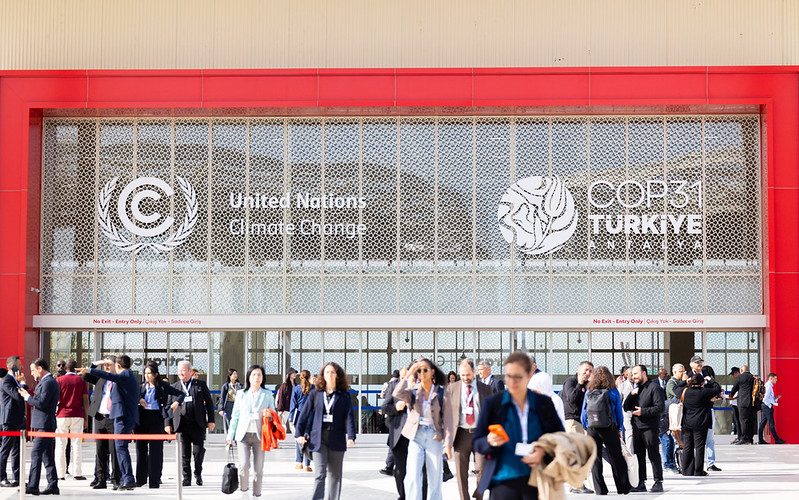
The United Nations COP31 climate summit collapsed without a final agreement on Sunday after negotiators failed to resolve deep divisions over fossil fuels and climate finance, bringing two weeks of negotiations and nearly two days of overtime talks to a fraught close in what became the longest UN climate conference on record.
Surpassing the 44-hour overtime record set at COP25 in Madrid in 2019, the Antalya summit ended without a consensus cover decision—the first time UN climate talks have failed to adopt a final deal since Copenhagen in 2009.
During the closing plenary, the European Union, the United Kingdom, and small island states including Tuvalu, Panama, and the Marshall Islands formally rejected the proposed draft text over its complete omission of fossil fuels and any commitment to transition away from coal, oil, and gas—language first secured at COP28 in Dubai in 2023. Critics condemned the draft as a step backward that relied heavily on carbon capture and removal schemes backed by major oil-producing nations while failing to provide adequate adaptation finance for developing economies.
Addressing the plenary, COP31 President and Turkish Environment Minister Murat Kurum confirmed that no new draft would be issued, stating: “I understand that there is no agreement on this text. For that reason, these decisions have not been adopted.” Australia’s COP31 President of Negotiations, Chris Bowen, described the impasse as “very disappointing,” identifying disagreements over fuels and climate finance as the primary dealbreakers.
Speaking on behalf of the EU, Ireland’s Minister for Climate Darragh O’Brien called the omission of fossil fuels “unconscionable,” warning that the text went “nowhere near the level of action that’s required to deal with climate change.” UK Energy Secretary Miatta Fahnbulleh termed the failure to reach a deal “immensely disappointing,” though she noted that discussions had sought to confront the reality that global warming is projected to overshoot the 1.5°C threshold.
Small island nations voiced sharp criticism of the draft’s emphasis on carbon capture technologies. Tuvalu’s Climate Minister Maina Talia remarked that negotiations felt dominated by oil-producing interests, while the Marshall Islands warned that endorsing a deal reliant on “false solutions” without stronger financial backing would betray frontline communities.
Conversely, Saudi Arabia, speaking on behalf of the League of Arab States, defended the inclusion of carbon capture and storage (CCS), rejecting claims of greenwashing and arguing that scientific assessments recognise a role for CCS alongside all viable mitigation technologies. Meanwhile, several major developing economies—including China, India, Pakistan, and Ghana on behalf of the African Group—indicated they were prepared to accept the compromise cover text to preserve multilateral momentum despite reservations over climate finance, loss and damage, and just transition language.
UN Secretary-General António Guterres expressed deep disappointment over the deadlock, stressing that while consensus eluded the negotiating room, “there is no ambiguity in the science.” Warning that the world cannot “put out the fire while pouring fuel on it,” he urged governments to accelerate the transition away from fossil fuels, deepen emissions cuts this decade, and scale up adaptation finance for vulnerable nations.
UN Climate Change Executive Secretary Simon Stiell cautioned that “the world cannot afford a repeat of this moment,” while noting that the conference still delivered progress on a just transition mechanism alongside parallel commitments to expand global geothermal energy supply by 2050, develop greener freight corridors, and raise electricity’s share of global energy to 35 per cent by 2035.
Although the collapse in Antalya does not erase existing obligations under the Paris Agreement or prior COP decisions, unresolved disputes over fossil fuel phase-out roadmaps and climate finance now shift directly to COP32 in Addis Ababa, Ethiopia.