








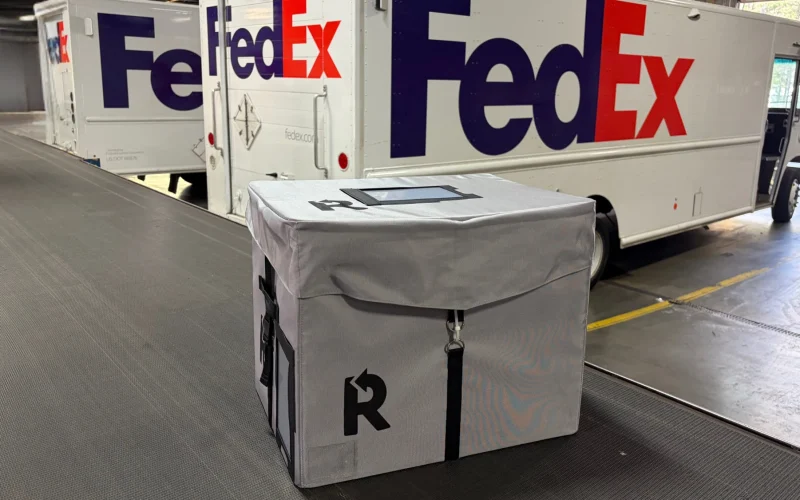
FedEx Corp has unveiled a new reusable packaging system for business-to-business (B2B) shippers, developed in collaboration with circular logistics specialist Returnity. The initiative introduces a bespoke, durable box design that allows customers to transition from traditional corrugated cardboard to reusable containers without incurring the handling fees typically associated with non-standard packaging.
The system is specifically engineered for closed-loop environments, such as store restocking and internal transfers, where return paths are predictable. Each collapsible box is designed to withstand up to 50 shipment cycles and carry loads of up to 22.7kg (50lbs). FedEx claims the model can reduce packaging spend by up to 30% per cycle and cut carbon emissions by between 64% and 88% compared to single-use alternatives, provided the non-return rate remains below 40%.
“In collaboration with Returnity, we have created the first scalable, reusable box solution for B2B customers, which is especially useful for our soft-goods shippers,” said Neil Gibson, senior vice president, global customer experience at FedEx. He noted that the partnership helps retailers “unlock meaningful cost savings while reducing environmental impact, all without sacrificing speed or reliability.”
The solution has already undergone successful pilots across North America, with shippers reporting improved labour efficiency, faster restocking, and lower product damage rates. Mike Newman, CEO of Returnity, praised the logistics giant’s approach, stating: “FedEx made reuse make sense by building the business case, doing the work, and creating a model for how circular logistics can succeed at scale.”
Unlike previous reusable attempts that struggled with the complexity of parcel networks, this design is fully automation-friendly and integrates directly into existing FedEx infrastructure, supporting the company’s broader vision for “smarter” supply chains.