







Fervo Energy, a leader in next-generation geothermal technology, has announced the successful closing of $421 million in non-recourse debt financing. The capital is earmarked for the first phase of its flagship Cape Station development, marking a pivotal shift for Enhanced Geothermal Systems (EGS) into the realm of bankable, utility-scale infrastructure.
The oversubscribed financing package signals a transition from early-stage bridge funding to a long-term project capital structure. Industry experts suggest this move disrupts the traditional narrative that “first-of-a-kind” green energy projects are too risky for traditional debt markets.
As energy markets grapple with surging demand from AI data centres, a resurgence in domestic manufacturing, and rapid electrification, Cape Station is positioned as a critical provider of “firm” (constant) carbon-free power.
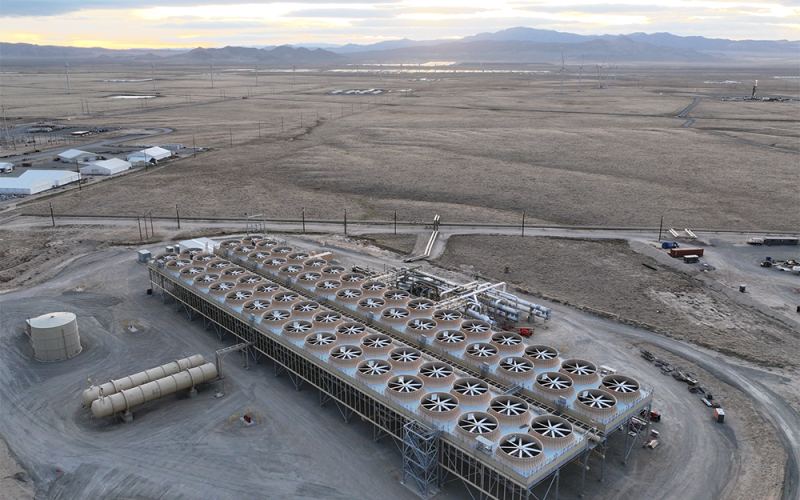
Located in Beaver County, Utah, the facility is scheduled to begin delivering electricity to the grid in 2026. It is expected to reach an operating capacity of 100 MW by early 2027, with a long-term goal of scaling to 500 MW. The project’s output is already fully committed through power purchase agreements (PPAs) with Southern California Edison, Shell Energy, and various community choice aggregators.
Fervo’s success lies in its integration of established oil and gas drilling techniques with AI-enabled exploration. “Non-recourse financing has historically been considered out of reach for first-of-a-kind projects,” said David Ulrey, CFO of Fervo Energy. “Cape Station disrupts that narrative. We have shown that EGS is a highly bankable asset class.”
The financing arrangement includes $309 million construction-to-term loan, $61 million tax credit bridge loan and $51 million letter of credit facility.
The deal was supported by a heavy-hitting consortium of international lenders. RBC Capital Markets served as financial advisor and coordinating lead arranger alongside British mainstays Barclays and HSBC, as well as BBVA, MUFG, and Société Générale. Other participants included J.P. Morgan, Bank of America, and Sumitomo Mitsui Trust Bank.
Sean Pollock, Managing Director at RBC Capital Markets, noted that as the need for affordable, clean power accelerates, EGS is set to become a “core energy asset class” for infrastructure lenders worldwide.