




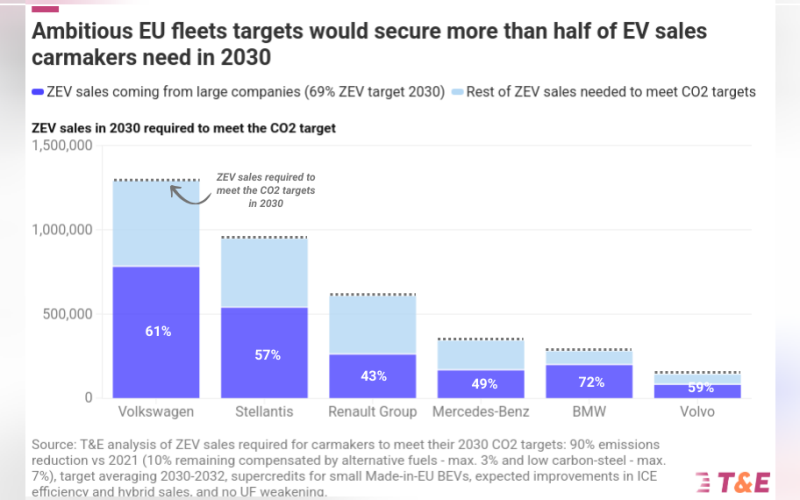
A proposed EU law requiring large companies to electrify their vehicle fleets could deliver more than half of the electric vehicle (EV) sales needed for carmakers to meet their 2030 CO₂ targets, according to new research by Transport & Environment (T&E).
T&E said an ambitious company cars law could generate up to 2 million new EV sales, covering 57% of the EV volumes manufacturers require in 2030. However, under the European Commission’s current proposal — which sets an average 45% electrification target for new cars registered by large companies — carmakers would secure only 37% of the EV sales needed to comply with EU CO₂ rules.
T&E analysed the impact of raising the target to 69% and excluding plug-in hybrids, in line with the medium ambition scenario in the Commission’s own impact assessment. Under that scenario, carmakers such as BMW (72%), Volkswagen (61%) and Volvo (59%) would secure a significant share of their required EV sales through corporate fleets.
The NGO said the Commission’s proposed targets would result in “business as usual”, with large companies required to electrify faster than the overall market in only six Member States. In Germany, for example, EV registrations among large firms would be just five percentage points above expected overall market levels. In 21 other Member States, companies would either lag behind or merely match broader EV uptake.
Sofie Grande y Rodriguez, Clean Fleets Manager at T&E, said: “Designing a fleets law that doesn’t require large companies to lead is like building a house that no one will ever live in. Lawmakers have two options. Either they increase the EV targets and drop PHEVs, or they fail at turning this law into the powerful demand-driving instrument it should be. It’s in the European car industry’s interests that they get this done right.”
T&E pointed to Belgium as evidence that fiscal reform can accelerate uptake. Following changes in 2021 that phased out tax advantages for internal combustion engine vehicles and plug-in hybrids, EVs accounted for 54% of corporate registrations in 2025. In Germany, where no comparable reform was introduced, EVs represented 19% of the corporate market.
The organisation said higher fleet targets would also support domestic manufacturing. In 2025, 74% of new corporate EVs registered in the EU were produced in Europe, a share expected to rise further if only EU-made EVs qualify for financial support under forthcoming legislation. A 69% EV-only fleet target could enable European manufacturers to sell up to 1.9 million additional EVs in 2030, compared with 1.2 million under the current 45% proposal.
“The EU fleets law is Europe’s secret weapon to turbo charge domestic car production,” Grande y Rodriguez added. “With made-in-EU EVs already being the favourite choice for corporate buyers when going electric, fleet targets will support European car manufacturers and jobs.”