






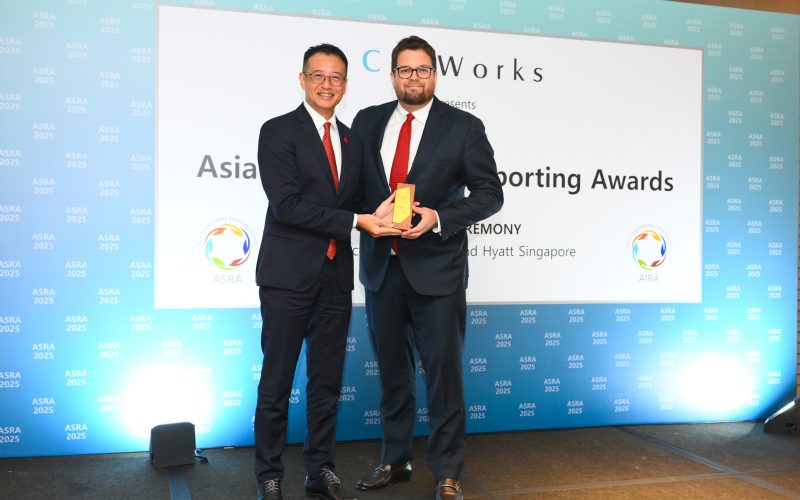
COFCO International’s Gold win for Asia’s Best Supply Chain Reporting at the 11th Asia Sustainability Reporting Awards reflects a year where the organisation focused on “transforming ambitions into reality beyond our operations.” In this exclusive interview, Allan Virtanen, Director of Communications and Sustainability, explains how improved rigour, clearer target-tracking and strengthened supply-chain disclosures helped raise the bar for transparency and accountability across global value chains.
Congratulations on winning at the 11th Asia Sustainability Reporting Awards. What does this recognition mean for your sustainability team and your organisation?
The fact that our report was recognised with the Gold Award in the Best Supply Chain Reporting category is a strong endorsement of our commitment to transparency, accountability and continuous improvement in ESG performance beyond our operations. It was especially meaningful to be recognised in Singapore, a key financial hub where many of our banking partners, lenders and our Global Financing Team are based. It demonstrates that our ESG reporting meets the expectations of the international financial community and many other stakeholders. The recognition also reflects the dedication of our teams across the globe, from origination to commercial, who are embedding sustainability in everything they do and helping transform ambitions into reality across our supply chains.
Sustainability reporting has evolved rapidly. How has your reporting approach matured over the past few years, and what were the biggest lessons from this journey?
Over the recent years, we have experienced first-hand how sustainability reporting has evolved. It has move from being primarily a communication channel for sharing non-financial information on how ESG impacts were addressed with stakeholders to becoming an advanced management tool. Today, it enables stakeholders and our leadership to reflect on ESG progress, strategic direction and financial risks and opportunities. It also helps demonstrate how long-term business resilience is being built amidst a dynamic business environment. The main lesson we took was that robust ESG reporting isn’t just about compliance and PR. It’s about accountability, transparency, ESG risk management and long-term business resilience.
The ASRA judges emphasise rigour, transparency, and impact. Which parts of your report do you feel best demonstrate these qualities?
In our 2024 report, we strengthened and expanded progress reporting for our material topics. We placed particular emphasis on those most relevant to our supply chains, including farmer engagement and capacity building, land use change and related greenhouse gas (GHG) emissions, and human rights due diligence. We also presented our targets and related progress more clearly, linking performance directly to long-term sustainability outcomes. Overall, what set us apart this year was the rigour and forward-looking nature of the disclosures, as we sought to demonstrate how we are transforming ambitions into reality beyond our operations.
Could you walk us through the process of materiality assessment — and how you are now integrating double materiality or value-chain impacts into your reporting?
Given COFCO International’s vast presence in the global agricultural value chains and the fact that we trade products with very different environmental and social profiles, we must ensure that our reporting and sustainability strategy are addressing the ESG topics that are indeed most material to our business. In the run-up to our 2024 report, we completed a new double materiality assessment aligned to CSRD requirements and, with it, identified the ESG impacts of our operations and supply chains, as well as the risks and opportunities faced by our business. This exercise proved valuable but complex. We began by conducting in-depth research to comprehensively map potentially material impacts, risks and opportunities. We then identified the most material topics by balancing the perspectives of the different external and internal stakeholder groups with existing internal knowledge, such as insights from our climate risk assessment and our human rights due diligence system. Going forward, we plan to review our list of material topics annually, as we build an improved understanding of how each topic affects and is affected by our business, and as we continuously engage different stakeholder groups and factor in changing priorities.
How do you ensure data accuracy and credibility across complex topics such as GHG emissions, supply-chain sustainability, and human rights?
We adhere to recognised standards and follow best sector practice wherever applicable to ensure that the ESG data we report is rigorous. For example, our GHG emissions are calculated in line with the GHG Protocol and the related progress reporting follows the requirements of the Science-Based Targets initiative (SBTi). Similarly, we disclose information on our human rights due diligence in alignment with the OECD Due Diligence Guidance for Responsible Business Conduct. Furthermore, our sustainability team includes dedicated specialists who are responsible for overseeing ESG data governance, ensuring the accuracy, transparency, and accountability of our reporting. We have comprehensive and robust data collection processes with quality control checks in place, and key selected data undergoes annual external verification. In our latest report, we expanded the assurance scope to cover our complex Scope 3 greenhouse gas emissions, a very material piece of information for supply chain reporting.
What new sustainability frameworks (for example, ISSB or TNFD) are you preparing to align with, and what challenges or opportunities do they bring?
In addition to the GRI Standards, UN SDGs and TCFD recommendations, our 2024 Sustainability Report was structured in line with upcoming European CSRD and ESRS standards, which are highly interoperable with the ISSB standards and TNFD recommendations. This voluntary alignment helps us ensure that current and future expectations of our investors, lenders and other stakeholders are adequately addressed. As we move forward, we remain attentive to evolving sustainability frameworks and seek to continuously improve our reporting, in line with best practice, improving transparency and comparability.
Reporting aside, which sustainability initiative or achievement from the past year are you personally most proud of?
I am proud of the measurable progress we have been making across all pillars of our sustainability strategy, but if I must pinpoint a specific example, I will say the measurable progress we are making on mitigating our Scope 3 GHG emissions through supply chain transformation and how that is translating into added business value. In 2024, we had our science-based emissions reduction targets validated by the SBTi, accelerated our deforestation- and conversion-free commitments and were happy to report significant progress on our targets.
How do you engage internal teams and business units in the sustainability agenda so that reporting reflects genuine performance, not just compliance?
The successful implementation of our sustainability strategy is fully dependent on the contribution of our employees, both at the corporate and business unit level. In fact, sustainability is one of our corporate values and all employees are empowered to make decisions that are aligned with our corporate culture. As part of our sustainability governance model, we seek to embed sustainability into everyday decision-making at all organisational levels, rather than treating it as a compliance exercise. We do so by providing teams with the knowledge, tools and support they need to embody our values. We see that new applicants joining COFCO are increasingly eager to understand how they can contribute to sustainability from the outset. This means it is rarely difficult to find people willing to engage, even if only in a light way. The nature of our industry is closely connected to the natural environment, which naturally fosters this mindset and sense of responsibility.
Many companies are still struggling to link sustainability KPIs with business results. How has your organisation made that connection visible in its strategy and disclosures?
In recent years, we have strived to integrate sustainability KPIs into our commercial, financial and risk management processes and, with that, generate measurable, added business value. More specifically, we have been increasing and reporting the volume of certified sustainable commodities and expanding the options available to customers looking for this type of products, for example, through rolling out our in-house COFCO International Responsible Agriculture Standard and Coffee Responsible Origin Programme. We have also integrated sustainability considerations in investment decisions and continued to rely on sustainable finance as a tool to lower cost of capital. For example, in 2024, we negotiated a US$600m sustainability-linked loan tied to our GHG emission reduction targets.
Finally, what advice would you give to other sustainability professionals aspiring to reach ASRA-winning standards in their reports?
Although there is no recipe for a perfect sustainability report, the best reports are those that consistently focus on what truly matters for the organisation’s stakeholders and present relevant information in a transparent and rigorous way. Understanding what truly matters depends on a well-thought materiality process with representation of different stakeholder groups. Reporting information with rigor and transparency requires robust ESG data governance and clarity on methodologies, gaps and what is done to address those gaps. In short, the best sustainability reports are those that not only meet disclosure requirements, but also help stakeholders understand how the company is positioning itself in the long-term and building business resilience.