







By Lucinda Lay, Founder & Managing Director, Responsible Business ESG Ltd
After a decade of embedding sustainability into corporate strategy, many organisations are discovering that ambition alone does not deliver trust or impact. The next phase of corporate leadership will not be defined by sustainability titles or targets, but by whether businesses are prepared to act responsibly when commercial reality collides with stated values.
Sustainability is no longer the point. Responsibility is.
For years, businesses have competed to demonstrate how seriously they take sustainability. New strategies. New targets. New executive titles. The rise of the Chief Sustainability Officer was meant to be the clearest signal of intent. Sustainability had finally made it to the top table.
And yet trust in business has not risen in step.
This is not because sustainability is misguided. It is because it has too often been framed as ambition rather than behaviour. Vision rather than conduct. Promise rather than proof.
My view is simple, and deliberately uncomfortable. The next era of leadership is not about sustainability strategy. It is about responsible business.
The uncomfortable truth about sustainability leadership
The Chief Sustainability Officer role was created to solve a strategic problem. Sustainability needed ownership. Boards needed accountability. Investors wanted a single point of contact.
In organisations that genuinely integrate sustainability into governance, capital allocation and risk management, the role can be powerful. In too many others, it has become symbolic.
Senior sustainability leaders are frequently asked to carry accountability without control. They inherit commitments they did not design and are judged on outcomes they cannot fully influence. When delivery falls short, the failure is framed as sustainability not working, rather than the organisation not changing.
This is not a criticism of individuals. It is a structural flaw. When authority over incentives, procurement and operational decisions sits elsewhere, credibility inevitably erodes.
Why responsible business is cutting through
Responsible business starts from a different place. It does not ask what the organisation wants to be known for. It asks how the organisation actually behaves.
How decisions are made when margins are tight. How suppliers are treated when leverage sits with the buyer. How growth is balanced with impact when trade-offs are real.
This framing matters.
Responsible business is harder to spin and harder to ignore. It pulls sustainability out of strategy decks and into contracts, policies, governance and culture. It focuses attention on conduct, not communications.
That is why many organisations are quietly shifting their language. Sustainability sounds aspirational. Responsible business sounds accountable.
This shift is increasingly visible across professional services, consumer-facing brands and mid-market firms. It reflects regulatory pressure, litigation risk and growing fatigue with ESG theatre. It also aligns with what employees and clients are demanding: fewer promises and better behaviour.
This is not a downgrade. It is a maturity shift.
There is a lazy narrative that frames responsible business as less ambitious than sustainability leadership. I reject that entirely.
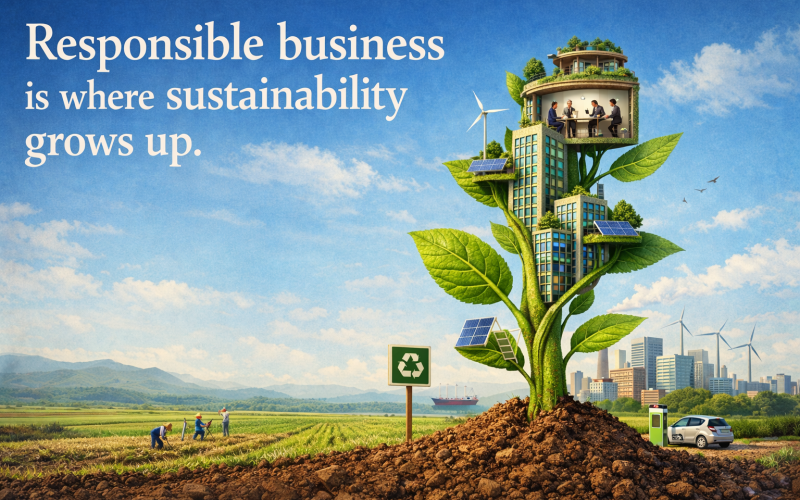
Responsible business is where sustainability grows up.
It is where climate commitments meet procurement frameworks. Where social impact meets labour practices. Where governance stops being a footnote and becomes a discipline.
Organisations that lead in responsible business are not abandoning sustainability. They are absorbing it into how they operate, rather than treating it as a parallel agenda.
That is why many of the most credible organisations no longer lead with grand sustainability claims. They lead with evidence, decisions and restraint. Trust is built less through stated purpose and more through consistent behaviour under pressure. Responsible business is the architecture that makes that possible.
What this means for leadership
The question is no longer which title sits on the organisational chart. The real question is where authority sits.
If sustainability remains owned by a single role, isolated from commercial reality, it will continue to disappoint. When responsibility is embedded into decision-making, incentives and governance, sustainability outcomes follow.
Some organisations will still benefit from a Chief Sustainability Officer. Others will achieve more impact through a Head of Responsible Business with mandate, credibility and proximity to operations.
The strongest businesses will stop debating titles altogether and start designing leadership models that reward responsible decisions, not just responsible narratives.
Why this matters now
The era of sustainability as aspiration is ending.
Regulators are watching. Employees are watching. Clients are watching. The media is watching for inconsistency, not innovation.
Responsible business is not a softer option. It is the harder one. It requires organisations to confront trade-offs honestly, behave consistently and accept scrutiny without defensiveness.
That is why it will define the next phase of corporate leadership. Not because it sounds better, but because it leaves less room to hide.
Author’s note
I work with businesses that genuinely want to do the right thing. Many have invested heavily in sustainability strategies, frameworks and senior leadership roles. They are not cynical or indifferent. But repeatedly, I see the same pattern emerge.
Sustainability is treated as an ambition rather than a discipline. It sits comfortably in strategy documents, but falters at the point where decisions become uncomfortable. When margins tighten. When supply chains are under strain. When growth targets and ethical commitments pull in opposite directions.
That is where sustainability either becomes real or quietly unravels.
This is why I believe responsible business matters more now than ever. It is not about aspiration. It is about behaviour. It asks harder questions about governance, accountability and decision-making. It focuses less on what organisations say they stand for and more on how they act when trade-offs are unavoidable.
In my experience, the organisations making the most credible progress are not those with the loudest sustainability narratives. They are embedding responsibility into how decisions are made, rewarded and challenged. They are moving away from sustainability as a standalone agenda and towards responsibility as a core operating principle.
This is not a rejection of sustainability. It is its maturation.
The next decade will belong to businesses that understand this shift. Not because it sounds better, but because responsibility has a way of revealing intent. And increasingly, that is what stakeholders, regulators and the public are paying attention to.