


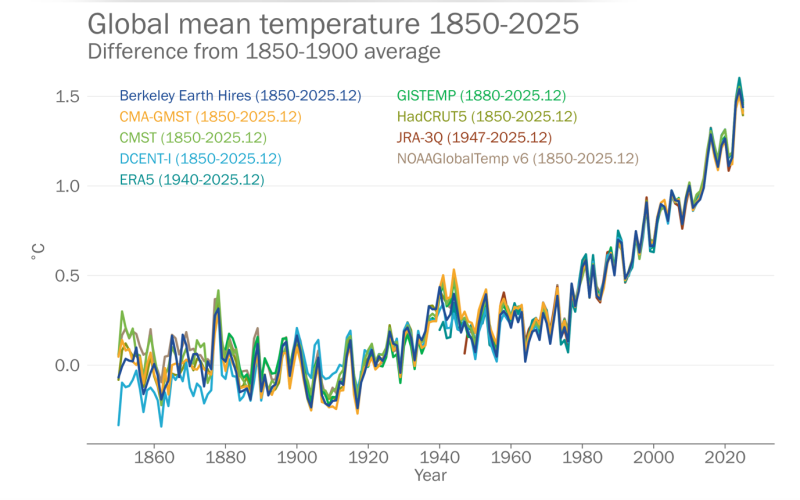
The World Meteorological Organisation (WMO) has issued a stark warning in its latest State of the Global Climate report, revealing that the Earth’s climate is more out of balance than at any point in observed history. Released on World Meteorological Day, the findings confirm that 2025 was either the second or third hottest year on record, concluding a decade that contains the eleven warmest years ever documented.
For the first time, the WMO has included the Earth’s energy imbalance as a primary climate indicator. This metric, which tracks the difference between the solar energy entering the atmosphere and the amount escaping back into space, reached a new peak in 2025. This equilibrium has been disrupted by record concentrations of greenhouse gases, which have now reached levels not seen for at least 800,000 years.
Oceans and ice under unprecedented stress
The report highlights the critical role of the global ocean, which has acted as a massive thermal buffer by absorbing 91% of the Earth’s excess heat. Over the past two decades, the ocean has absorbed the equivalent of eighteen times the total annual human energy consumption each year. Consequently, ocean heat content reached a record high in 2025, with warming rates more than doubling since the mid-20th century.
The cryosphere is showing similar signs of distress:
- Arctic sea ice: The maximum daily extent following the winter freeze was the lowest ever recorded.
- Antarctic sea ice: Extent reached its third lowest level, following consecutive record lows in 2023 and 2024.
- Glacier melt: Significant ice loss continued unabated, with particularly exceptional melting observed in Iceland and along the North American Pacific coast.
Human and economic toll
The shift in the Earth’s energy balance is manifesting as increasingly frequent and severe weather events. In 2025 alone, heatwaves, wildfires, and floods resulted in thousands of fatalities and billions of pounds in economic losses.
United Nations Secretary-General António Guterres described the findings as a “state of emergency,” noting that every key climate indicator is now “flashing red.” He emphasised that the acceleration of climate chaos is directly linked to a global “addiction to fossil fuels,” which threatens both environmental and international security.
The report also underscores a growing health crisis. Rising temperatures are facilitating the spread of vector-borne diseases, such as dengue fever, which is now the world’s fastest-growing mosquito-borne illness. Furthermore, over 1.2 billion workers—roughly one-third of the global workforce—now face significant heat-related health risks annually.
A call for proactive protection
WMO Secretary-General Celeste Saulo stressed that while some changes, such as ocean warming and sea-level rise, are now irreversible on a centennial scale, improved meteorological data can still save lives. She urged nations to move from reactive responses to proactive prevention by integrating climate data into health and disaster management systems.
“When we observe today, we don’t just predict the weather, we protect tomorrow,” Saulo stated, echoing the theme of this year’s World Meteorological Day: Observing Today, Protecting Tomorrow.