








Google has detailed a replicable ‘net-zero warming’ strategy in a case study published by the Science Based Targets initiative (SBTi), demonstrating how corporations can address Ongoing Emissions Responsibility (OER) by pairing near-term superpollutant abatement with long-term durable carbon dioxide removal (CDR).
While corporate decarbonisation targets focus on reducing operational and value-chain footprints, residual carbon dioxide emissions continue to drive near-term peak warming and extend long-term temperature overshoot. To bridge this gap, Google’s framework combines immediate, scale-ready mitigation tools—such as methane abatement and nature-based carbon removal—to neutralise warming over the next decade, while phasing in permanent CDR technologies capable of storing carbon for at least 1,000 years.
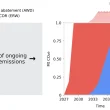
Under Google’s standardised mitigation templates, one tonne of methane abatement (measured in CO₂e at GWP20) balances the warming impact of one tonne of CO₂ emissions for 12 years, establishing a 12-year window within which one tonne of durable CDR must be delivered to permanently neutralise long-term warming.
Google has operationalised this model through a commercial partnership with carbon removal developer Terradot across 500,000 acres of rice farmland in Brazil. The project deploys Alternate Wetting and Drying (AWD) irrigation techniques to periodically aerate rice paddies, suppressing methane-generating microbes without reducing crop yields to deliver one megatonne of CO₂e methane abatement by 2030. Simultaneously, finely crushed basalt is spread across the same fields to accelerate Enhanced Rock Weathering (ERW), a geochemical process that converts atmospheric carbon dioxide into dissolved bicarbonate ions, permanently removing one megatonne of CO₂ by 2040.
By extending the durable carbon removal delivery timeline across a 12-year window rather than requiring immediate geological removal, the hybrid structure lowers operational costs and advances unit economics toward a $100 per tonne benchmark.
The model also aligns with upcoming regulatory and voluntary disclosure frameworks. Under criterion C45.2 of the SBTi Corporate Net-Zero Standard Version 2.0, durable carbon removal delivered after 2035 can be banked toward long-term corporate net-zero targets, allowing organisations to manage current warming impacts while pre-securing future compliance supply.
Kate Brandt, Chief Sustainability Officer at Google, stated that the net-zero warming framework establishes a replicable pathway for corporate buyers to balance immediate atmospheric warming while financing the early-stage durable carbon removal technologies required for long-term climate stability.