




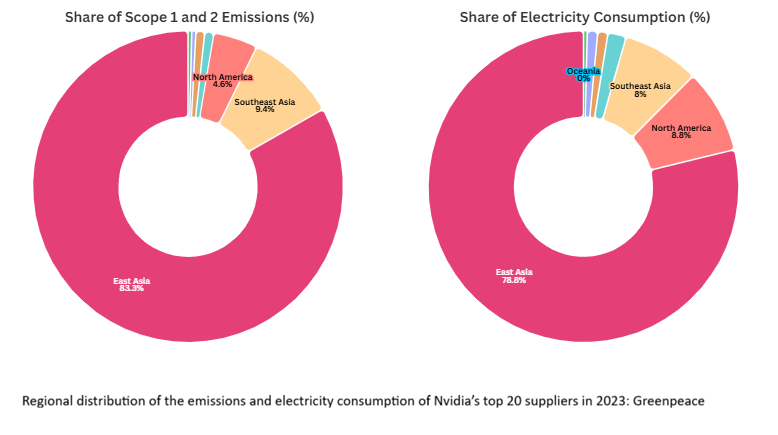
A new analysis by Greenpeace East Asia has raised concerns over the environmental impact of Nvidia’s rapid growth, warning that the company’s booming AI-driven profits are accompanied by rising emissions across its supply chain.
The report, titled “Nvidia’s Green Illusion,” comes as the semiconductor giant reported record quarterly revenue last month and its market valuation approached $5 trillion. According to the analysis, Nvidia’s expanding operations are contributing to higher greenhouse gas emissions and risk creating a “fossil fuel lock-in” across its East Asian manufacturing network.
Greenpeace examined Nvidia’s 20 largest suppliers, which account for more than 50% of its cost of goods sold, and identified what it described as a “decarbonisation deficit” across the company’s supply chain in East Asia. The report says Nvidia has not made direct investments in renewable energy in its East Asian manufacturing hubs, shifting the emissions burden to suppliers in Taiwan and South Korea that rely heavily on coal and gas.
Katrin Wu, Greenpeace East Asia Supply Chain Project Lead, said: “In contrast to Nvidia’s soaring valuation, its escalating electricity consumption and emissions in East Asia have largely gone unnoticed. As a leading company, Nvidia has both the responsibility and capability to decarbonise its supply chain. Profit should never come at the expense of our planet, nor should local communities in East Asia bear this burden.”
The analysis found that Nvidia’s supply chain emissions more than doubled in three years, rising from 2.97 million tonnes of CO₂ equivalent in fiscal year 2023 to 6.03 million tonnes in fiscal year 2025, roughly equivalent to the annual emissions of more than 125,700 US households. Greenpeace said the company has yet to set a clear emissions reduction target or renewable energy transition goal for its supply chain.
East Asia accounted for 83% of Scope 1 and Scope 2 emissions and nearly 79% of electricity consumption among Nvidia’s top suppliers in 2023, highlighting the region’s central role in the company’s manufacturing network.
The report also identified a major renewable energy gap, with suppliers in East Asia sourcing just 24.09% of their electricity from renewables, compared with 80.55% among North American suppliers.
Major suppliers including TSMC, Samsung and SK Hynix have seen electricity consumption rise by up to 16% between 2022 and 2024, while renewable energy adoption increased by less than 4% over the same period, the report said.
Greenpeace has called on Nvidia to cut supply chain emissions, invest directly in renewable energy infrastructure near its manufacturing hubs, and set a 2030 deadline for major suppliers to transition to 100% renewable energy.
“Decarbonising the supply chain is a complex challenge, but Nvidia is uniquely positioned to lead given its abundant resources and substantial market influence,” Wu said. “While local renewable resources may be limited, Nvidia has the opportunity—and the obligation—to invest in renewable energy infrastructure near its suppliers. Companies like Apple and Google have already demonstrated the benefits of such investments.”
“Nvidia must move beyond just buying offsets and start investing directly in renewable energy infrastructure near its manufacturing hubs. We need a ‘Green AI’ mandate that ensures the chips of the future aren’t powered by the fuels of the past.”