











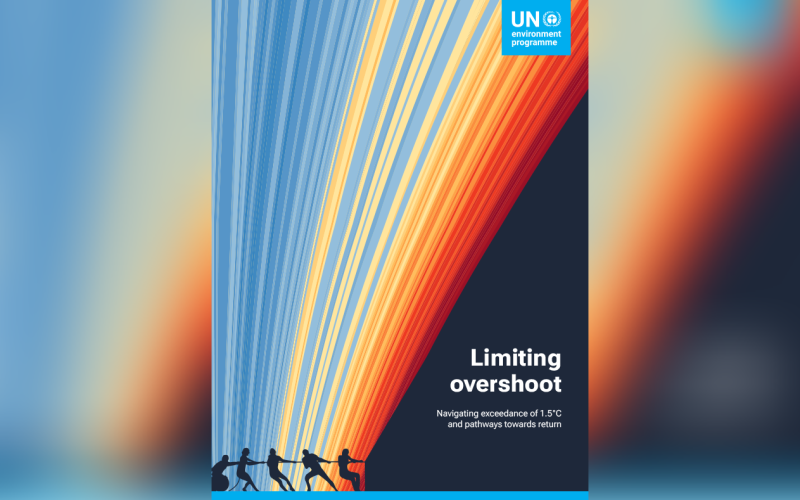
Global temperature rise is projected to exceed the 1.5°C threshold within the next few years, according to a report published by the UN Environment Programme (UNEP).
The report, titled Limiting Overshoot, states that while crossing the 1.5°C threshold established by the Paris Agreement is increasingly likely, returning global temperatures to below that level remains technically possible. UNEP advocates for an “overshoot, peak, and decline” framework designed to restrict the magnitude and duration of temperature spikes above pre-industrial levels.
Under the most optimistic modeling, warming is expected to peak at 1.8°C before declining, though higher peak trajectories remain probable without immediate intervention. The report warns that exceeding 1.5°C increases the likelihood of reaching irreversible planetary tipping points, including the destabilisation of polar ice sheets, degradation of the Amazon rainforest, and disruption to the Atlantic Meridional Overturning Circulation.
António Guterres, United Nations Secretary-General, stated: “This summer’s scorching heat, raging wildfires and deadly floods are a warning of what lies ahead. We must make the overshoot above 1.5 degrees as small and short as possible. That demands an overshoot of ambition.”
The strategy outlined in the report requires two parallel pillars:
- Emissions Reductions & Net-Negative Transition: Rapid, sustained cuts across all greenhouse gases—including methane—to reach net-zero emissions, followed by long-term net-negative emissions using governed Carbon Dioxide Removal (CDR) technologies like afforestation and direct air capture.
- Transformational Adaptation: Broadened adaptation measures to reduce societal and economic vulnerability to climate impacts, while recognising that physical limits to adaptation exist at higher temperature thresholds.
Inger Andersen, Executive Director of UNEP, noted: “There are no good outcomes if we remain above 1.5°C. Across the globe, extreme heatwaves are already proving that climate impacts will strike faster, hit harder, and last longer – costing more lives and causing deeper disruption. Now is the time we must double down on climate action. We can – and must – get on the right path. By cutting greenhouse gas emissions, strengthening resilience and adaptation, and ensuring exceedance of 1.5°C is as small and short as possible.”
The report emphasises that CDR must complement, rather than replace, deep decarbonisation efforts across energy, industrial, and transport sectors, warning that a return to safe temperature levels depends on keeping peak warming well below 2°C.