






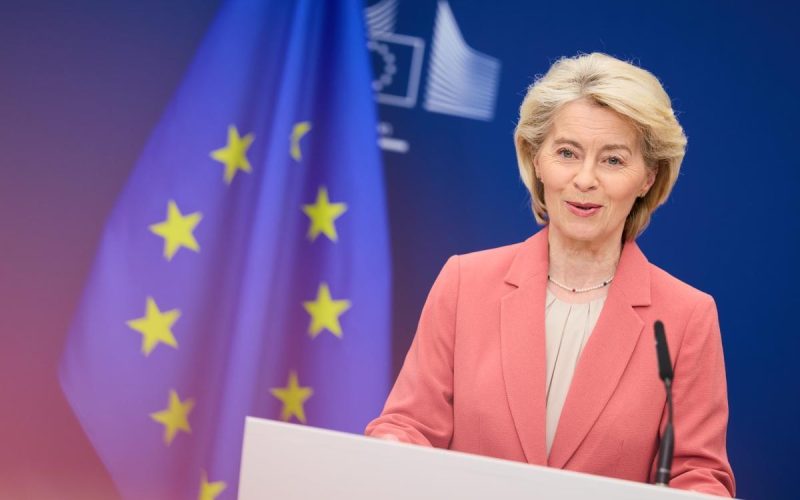
European Commission President Ursula von der Leyen said Europe’s move away from nuclear power had been a “strategic mistake”, warning that recent geopolitical tensions had exposed the risks of relying heavily on imported fossil fuels.
Speaking at a nuclear energy summit near Paris, von der Leyen said the reduction in nuclear generation had weakened Europe’s energy security.
“This reduction in the share of nuclear was a choice. I believe that it was a strategic mistake for Europe to turn its back on a reliable, affordable source of low-emissions power,” she said.
She added that dependence on fossil fuels had left Europe exposed to volatile global markets. “For fossil fuels, we are completely dependent on expensive and volatile imports. They are putting us at a structural disadvantage to other regions,” she said.
Von der Leyen described the ongoing conflict involving Iran as “a stark reminder” of the vulnerabilities created by reliance on fossil fuel imports. The war has damaged key oil refineries and disrupted shipping through the Strait of Hormuz, one of the world’s most important oil transit routes.
At the summit, she announced a €200 million ($230 million) fund aimed at supporting nuclear innovation in Europe.
According to von der Leyen, nuclear power accounted for about one-third of Europe’s electricity generation in 1990 but has declined to around 15% today.
France has continued to rely heavily on nuclear energy, while Germany phased out most of its nuclear capacity after the Fukushima nuclear disaster.
French President Emmanuel Macron said nuclear power remains essential for both energy independence and climate goals. “Nuclear power is key to reconciling independence — and thus energy sovereignty — with decarbonisation and carbon neutrality,” he said.
The European Commission also set a target to deploy small modular reactors (SMRs) across the EU by 2030 and to harmonise regulatory frameworks among member states.
Unlike conventional nuclear plants that typically generate about 1,000 MW of electricity, SMRs produce around 300 MW and can be manufactured in factories, allowing faster and potentially lower-cost deployment.
During the summit, Greenpeace activists briefly disrupted proceedings by storming the stage and holding banners criticising nuclear power and Europe’s continued imports of uranium from Russia. Around a dozen protesters also blocked vehicles arriving at the venue.