







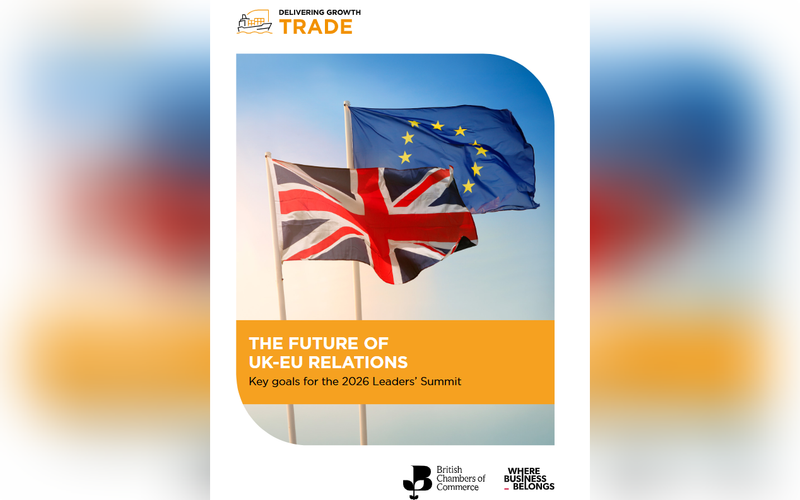
The British Chambers of Commerce (BCC) has called on UK Prime Minister Andy Burnham to use this week’s Leaders’ Summit in Brussels to finalise targeted trade and climate agreements designed to reduce commercial friction and compliance costs for British exporters.
Ahead of the summit, the business group stated that the UK delegation must secure three core agreements: the removal of export and import charges on animal and plant products, the creation of a single linked UK-EU carbon trading market free of administrative fees and red tape, and the establishment of a capped youth experience mobility scheme. According to BCC economic modelling, concluding these three agreements could expand the UK economy by an estimated £12 billion by 2040—a figure approaching the total fiscal headroom set out by the Chancellor in the 2026 Budget.
The intervention follows new BCC survey research of more than 1,000 British firms, which indicates that nearly six years after Brexit, expanding regulatory requirements, customs checks, and value-added tax (VAT) rules continue to constrain cross-border trade alongside rising global protectionism and the European Union’s emerging ‘Made in Europe’ industrial policy.
Survey data reveals that 56 per cent of all exporting businesses—and 57 per cent of manufacturers—identify the removal of EU customs paperwork and border delays as critical to business growth. Additionally, 43 per cent of exporters cite tariffs, quotas, or rules of origin as operational barriers, while 35 per cent highlight EU VAT compliance requirements as a direct impediment. Only 14 per cent of surveyed exporters reported facing no trade barriers with the bloc.
Individual exporters polled by the BCC reported that removing existing border and tax compliance hurdles could reduce direct shipping, legal, and warehousing expenses by between 10 and 25 per cent while boosting export revenues.
Shevaun Haviland CBE, Director General of the BCC, stated that British businesses require immediate relief after navigating successive shocks from energy price spikes to tax increases and mounting post-Brexit bureaucracy. She noted that health certificate charges currently add thousands of pounds to every container of agri-food products shipped to the EU, while linking the UK and EU emissions trading schemes would eliminate hundreds of millions of pounds in compliance fees and administrative overhead.
While acknowledging that broader structural negotiations remain necessary—including rules of origin for electric vehicles, defence cooperation, and the EU’s ‘Made in Europe’ agenda—Haviland emphasised that concluding the three immediate agreements would provide vital financial breathing space for small and medium-sized enterprises trading with Europe.