






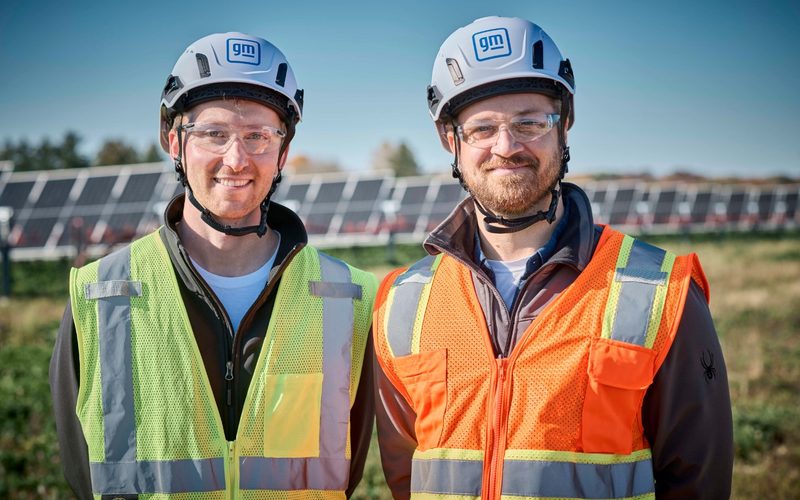
General Motors (GM) has announced its largest clean-energy commitment to date, entering into a virtual power purchase agreement (VPPA) with NorthStar Clean Energy as the primary offtaker for two utility-scale solar generation facilities in Michigan.
The agreement encompasses a utility-scale solar project in Branch County alongside the Lake Iris solar facility in St. Clair County. Both developments are designed to bolster grid capacity in Michigan and strengthen the energy foundation supporting GM’s vehicle, battery, and technology manufacturing operations across the state.
GM plans to apply the renewable energy credits (RECs) generated by the two installations toward the electricity purchased for its manufacturing facilities. Securing long-term renewable power agreements enables the automaker to improve energy cost predictability and insulate its operations against fuel-market volatility amid rising electricity demand from electrification, artificial intelligence, and domestic manufacturing.
The announcement builds upon GM’s milestone achieved in 2025, when it became the first US automaker to secure sufficient renewable energy to match 100 per cent of electricity consumption across all its US facilities. Since 2018, the company has reduced its Scope 1 and 2 operational greenhouse gas emissions by 52 per cent.
Beyond grid decarbonisation, the Branch and Lake Iris developments generated more than 550 full-time local construction jobs during development. Across the United States, GM’s broader renewable energy portfolio has delivered nearly $2 billion in economic impact and supports approximately 1,500 construction roles annually.
At the local level, the Branch County project enabled Bethel Township to secure a $1 million Renewables Ready Communities Award to fund municipal infrastructure, including road improvements and a township hall expansion. Meanwhile, the Lake Iris site will establish a native pollinator habitat across the solar array grounds—supported by GM in collaboration with ecological researchers—to enhance local biodiversity, improve solar-panel thermal efficiency, and reduce long-term site maintenance costs.