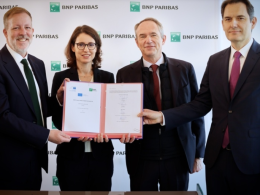









Spanish financial group BBVA, operating through its Turkish subsidiary Garanti BBVA, has announced its support for the expansion of the Future Supplier Initiative into Türkiye, aiming to unlock decarbonisation financing for local textile manufacturers and address Scope 3 supply chain emissions across the global fashion industry.
As a key strategic sourcing market and one of the world’s leading textile manufacturing hubs, Türkiye plays a central role in international apparel supply chains. The rollout comes during the year Türkiye hosts the COP31 UN Climate Change Conference, where BBVA serves as the summit’s Global Banking Partner.
The Future Supplier Initiative employs a collaborative financing model that connects international fashion brands, financial institutions BBVA and Garanti BBVA, and technical advisory partner Guidehouse. By pooling brand demand and financial backing, the programme removes capital barriers that frequently prevent manufacturers from upgrading facilities, enabling Turkish textile suppliers to access more competitive financing terms for energy efficiency upgrades, renewable energy adoption, and low-carbon production technologies.
For Türkiye’s textile sector, improved access to transition capital is designed to safeguard long-term export competitiveness while helping domestic producers meet tightening environmental standards from global buyers. Simultaneously, the shared supply chain structure allows participating fashion brands to tackle upstream Scope 3 emissions at scale.
Thibaud Escalon, Managing Director responsible for Sustainability and Low Carbon Advisory for the Consumer sector at BBVA Corporate & Investment Banking (CIB), stated that decarbonising the textile industry requires coordinated action among brands, suppliers, and lenders, noting that combining BBVA’s global sustainable finance structuring with Garanti BBVA’s local market relationships will accelerate capital deployment toward cleaner manufacturing models.