








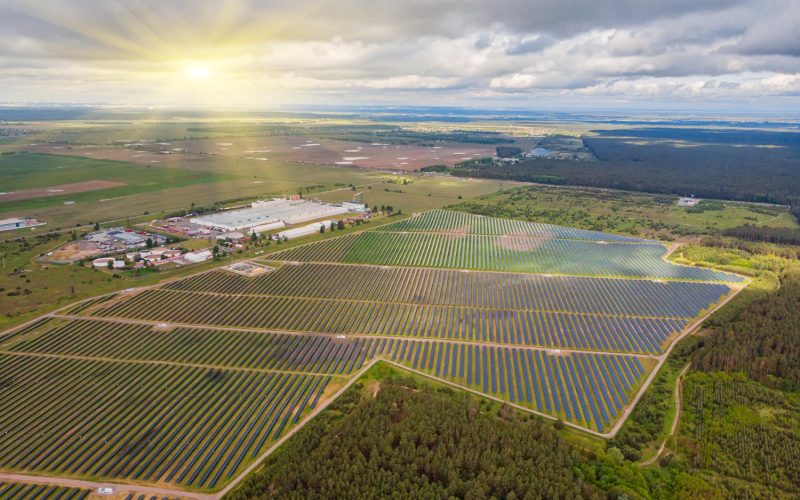
The European Bank for Reconstruction and Development (EBRD) has arranged a major international financing package to build a 1.2-gigawatt (GW) solar power plant integrated with a 600-megawatt-hour (MWh) battery energy storage system (BESS) in Minya, Egypt. Once complete, the project will be the largest combined solar generation and utility-scale battery facility in Egypt and Africa.
The EBRD is organizing a debt facility of up to $265 million for special purpose vehicle Nefer Menya for Renewable Energy S.A.E. The entity is owned by Infinity Power—a joint venture between Infinity and Masdar—and HAU Energy B.V., which is owned by Meridiam, Hassan Allam Utilities, and the EBRD.
The EBRD’s contribution includes a $160 million A-loan from its own funds, a $75 million B-loan syndicated to Bank of Jordan, and up to $30 million in concessional financing from the Climate Investment Funds’ Clean Technology Fund (CTF).
The overall debt financing package totals $566 million, with co-financing provided by German development bank DEG, the Dutch Entrepreneurial Development Bank (FMO), and France’s Proparco.
Key operational, environmental, and social aspects of the development include:
- Grid Stability Infrastructure: Combines 1.2 GW of solar PV generation with a 600 MWh storage facility to capture daytime solar output and dispatch power into the national grid during evening peak demand periods.
- Power Purchase Agreement: Off-take will be secured by the Egyptian Electricity Transmission Company under a 25-year corporate agreement.
- Emissions Offsetting: Expected to power over 1.4 million homes while avoiding more than 1.5 million tonnes of carbon dioxide emissions annually.
- Policy Alignment: Supports the EBRD-led Energy Pillar of Egypt’s Nexus of Water, Food and Energy (NWFE) platform, which targets the addition of 10 GW of private renewable energy capacity alongside the retirement of 5 GW of inefficient thermal power assets.
- Workforce Development: Includes CTF technical cooperation funding to establish two accredited green-skills training programmes in Minya governorate, while supporting workforce diversity initiatives within Hassan Allam Utilities.
Aida Sitdikova, EBRD Director of Sustainable Infrastructure in the Middle East and Africa, stated that combining utility-scale solar generation with battery storage strengthens Egypt’s energy security and provides a cost-effective template for grid-resilient renewable energy deployment across the region.