








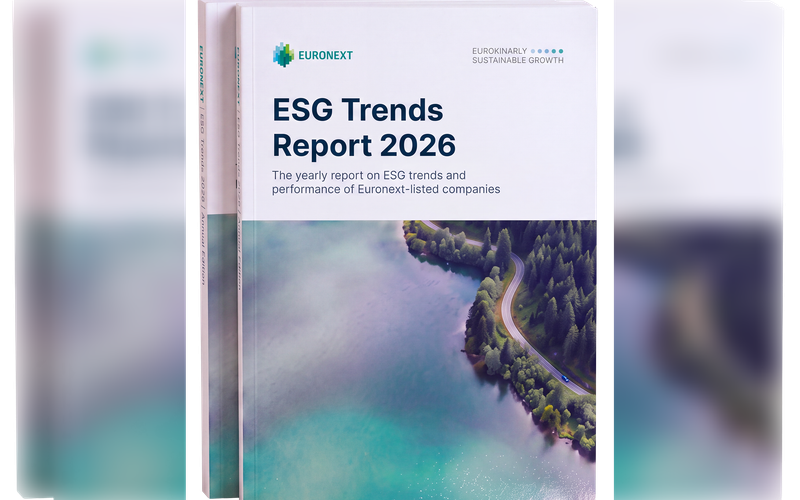
Pan-European exchange operator Euronext has published its 2026 ESG Trends Report to coincide with the start of Euronext Sustainability Week 2026, offering a data-backed assessment of sustainability performance across its listed markets.
The report aggregates verified corporate disclosures from over 1,680 Euronext-listed companies across 35 countries, representing approximately 90 per cent of issuers on the exchange and a total market capitalisation of €7.2 trillion. The underlying dataset incorporates more than 125,000 verified data points dating back to 2020 without relying on estimates.
Analysis of the reported disclosures shows progress across operational greenhouse gas reductions, energy efficiency, and governance structures, alongside adjustments driven by changes to the European Union’s regulatory framework.
Key findings from the 2026 dataset include:
- Greenhouse Gas Emissions: Companies disclosing metrics consistently over the past three years achieved an average 7 per cent reduction in combined Scope 1 and Scope 2 location-based emissions. Scope 3 supply-chain disclosures stabilized overall, remaining a primary operational area for data improvement.
- Energy Intensity: Large-cap issuers maintained an average 19 per cent reduction in energy intensity—measured in MWh per million euros of revenue—driven by capital investments, elevated energy costs, and corporate efficiency targets.
- Board Diversity: Female representation on corporate boards reached 35.4 per cent in 2025, marking an increase of 2.2 percentage points since 2023. Management board representation remained steady over the same period.
- Regulatory Reporting: EU Taxonomy disclosures saw a minor decline due to the EU’s Omnibus simplification package and recalibrated Corporate Sustainability Reporting Directive (CSRD) timelines, shifting corporate focus towards auditability and data quality.
- Science-Based Targets: Over 250 Euronext-listed issuers are engaged with the Science Based Targets initiative (SBTi). Within this group, 233 companies hold approved near-term targets, while 117 have formally committed to net-zero glidepaths.