






Tech giant Google has detailed a three-year strategic collaboration with off-grid clean energy provider Ignite Energy Access to overcome mapping, logistical, and monitoring barriers to expanding solar power across sub-Saharan Africa.
The initiative, conducted through Google’s Startups for Sustainable Development programme, supports Ignite’s target to connect 100 million people across the continent to electricity by 2030. Across sub-Saharan Africa, approximately 600 million people currently live without grid power, relying primarily on kerosene and candles for home lighting.
To address challenges in reaching remote communities, Google researchers and engineers worked alongside Ignite to develop a operational framework powered by geospatial data and artificial intelligence.
Key technical and operational pillars of the partnership include:
- Geospatial household identification: Combines satellite imagery with Google’s Open Buildings dataset and custom routing algorithms to identify unmapped rural homes lacking formal addresses.
- Supply chain and route optimisation: Utilises Google’s Operations Research (OR) models to evaluate regional logistics networks, helping determine optimal locations for central warehouses and distribution hubs while factoring in transportation costs, vehicle limits, and inventory capacity.
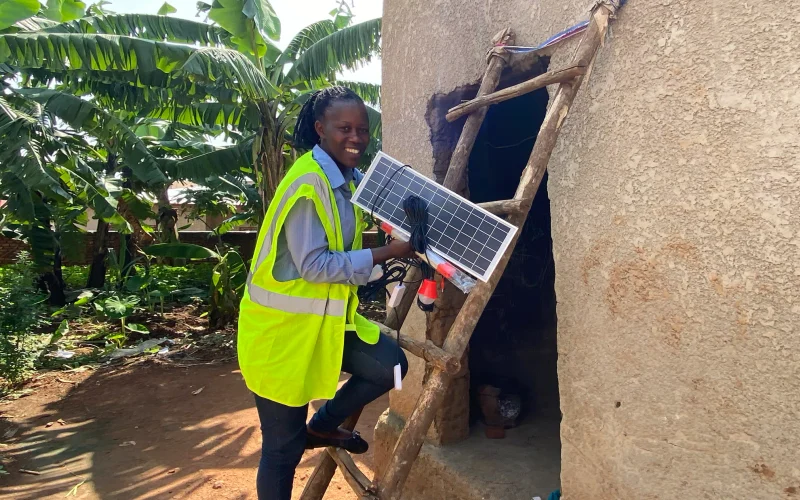
- Satellite-based installation mapping: Applies computer vision models fine-tuned with ground-truth drone data provided by Ignite to detect individual rooftop solar panels from space, enabling teams to map active installations and identify underserved areas.
- Emissions reduction progress: In the first half of 2026 alone, the partnership facilitated an estimated 160,000 tonnes of CO2 equivalent emissions reductions, supported by the delivery of 3.7 million solar devices across the region since 2023.
Yariv Cohen, Co-Founder and Chief Executive Officer of Ignite Energy Access, noted that bringing reliable solar power to off-grid communities drives immediate local economic development, enabling small businesses to operate, students to study after dark, and agricultural producers to process crops locally.
The partnership forms part of Google’s target to support global partners in reducing one gigaton of carbon-equivalent emissions annually by 2030. Moving forward, Google and Ignite are expanding their joint efforts to model community-level micro-grids capable of supporting high-power clean electric cooking systems to replace traditional wood and charcoal stoves.