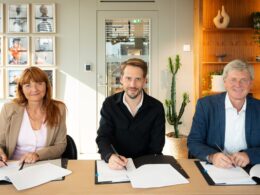








Hoffmann Green Cement Technologies has signed a strategic partnership with agricultural cooperative group Terrena to integrate its cold-produced, 0 per cent clinker cements into agricultural infrastructure projects across Western France.
Headquartered in Ancenis, Terrena is a leading agricultural cooperative representing 17,000 member farms, 13,000 employees, and 118 retail locations across the Pays de la Loire region and Western France. Under the agreement, Terrena will incorporate Hoffmann Green’s low-carbon cement technology into the construction of foundations and farm buildings.
The collaboration supports Terrena’s “Agriculture with Positive Impacts” initiative, which aims to reduce operational carbon footprints across its supply chain. For Hoffmann Green, the agreement marks a key step in its market diversification strategy, expanding the commercial deployment of its clinker-free cement beyond traditional commercial and residential property markets into heavy agricultural infrastructure.
Key details and operational highlights include:
- Low-carbon farm infrastructure: Terrena will integrate 0 per cent clinker cement into building foundations and structural elements across member farms to lower the embodied carbon of regional agricultural facilities.
- Commercial expansion: The partnership opens access to the agricultural construction sector in Western France, representing a high-volume target market for decarbonised building materials.
- Technology profile: Hoffmann Green’s proprietary cold-manufacturing process produces cement without traditional clinker, resulting in significantly lower carbon dioxide emissions compared to conventional Portland cement production.
Julien Blanchard and David Hoffmann, Co-founders of Hoffmann Green Cement Technologies, stated: “This collaboration fully reflects our ambition to diversify the markets addressed by Hoffmann Green and to bring the benefits of our 0% clinker cement technology to new cement-intensive sectors. Agricultural buildings represent a particularly attractive market for our development, and we are convinced that our technology can make a tangible contribution to reducing the carbon footprint of the structures built to support farmers in their projects.”
Matthieu Jamoteau-Bouquet, Construction Materials Market Manager at Terrena, added: “Reducing the carbon footprint of our activities and supporting our members in the transition of their agricultural operations are at the heart of our Positive Impact Agriculture approach. Integrating Hoffmann Green’s solutions into our new agricultural structures marks another tangible step forward in delivering on this ambition. By using 0% clinker cements, we aim to help reduce the carbon footprint of buildings constructed across our regions, while supporting the emergence of innovative and sustainable solutions for the agricultural sector.”