







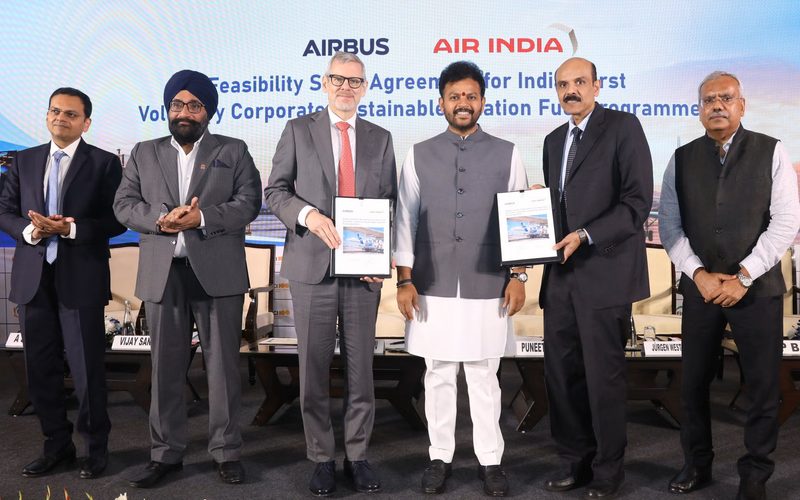
Air India and European aerospace manufacturer Airbus have entered into a feasibility study agreement to develop the framework for India’s first voluntary corporate Sustainable Aviation Fuel (SAF) programme, aiming to enable businesses to reduce lifecycle carbon emissions associated with corporate air travel.
The agreement was signed by Jürgen Westermeier, President and Managing Director of Airbus India and South Asia, and P Balaji, Group Head of Governance, Risk, Compliance (GRC) and Corporate Affairs at Air India, in the presence of Union Minister of Civil Aviation Kinjarapu Rammohan Naidu.
Under the proposed framework, Air India and Airbus will evaluate a commercial model allowing the carrier to procure and deploy SAF on selected routes while selling or transferring the associated Scope 3 SAF certificates (SAFc) to eligible corporate customers. Verified lifecycle emissions reductions—calculated by benchmarking certified renewable or waste-derived aviation fuels against conventional jet fuel using internationally recognised standards—will allow participating organisations to account for and report progress toward the aviation sector’s 2050 net-zero carbon emissions goal set by ATAG, IATA, and ICAO.
Tewolde Gebremariam, Chief Executive Officer and Managing Director of Air India, stated that achieving aviation decarbonisation requires collective action across the industry, adding that establishing a credible mechanism for corporate SAF demand is critical to scaling domestic production and building a sustainable aviation ecosystem in India.
Jürgen Westermeier, President and Managing Director of Airbus India and South Asia, noted that SAF holds the most immediate potential to decarbonise flight, describing the collaboration with Air India as a vital step toward accelerating regional adoption and inviting wider corporate participation.
P Balaji, Group Head of GRC and Corporate Affairs at Air India, emphasised that building a viable SAF market depends on sustained demand and cross-industry participation, noting that the framework is designed to give businesses an active role in accelerating India’s clean aviation transition.
The feasibility study complements broader decarbonisation initiatives underway across both organisations. Air India is executing a fleet renewal programme comprising 600 aircraft on order—including 350 from Airbus—alongside expanded non-stop city pairs, upgraded route optimisation software, single-engine taxiing, autonomous electric vehicle towing, frequent engine washes, and reduced single-use cabin plastics.