







By Rajesh Chhabara
As companies prepare for the adoption of the ISSB Standards, much of the focus has understandably been on implementation mechanics: interpreting technical requirements, assigning reporting responsibilities, improving data systems and closing disclosure gaps.
Those are necessary tasks. But they are not where the greatest risk lies.
The more consequential challenge for many organisations is governance.
Too many companies still appear to be approaching IFRS S1 and IFRS S2 as reporting compliance exercises to be managed by sustainability and reporting teams, with the Board stepping in toward the end of the process for review and approval. That mindset may have been sufficient for earlier generations of sustainability reporting. It is unlikely to be sufficient now.
Although the ISSB Standards are widely described as disclosure standards, that description can be misleading if interpreted too narrowly. What IFRS S1 and IFRS S2 ultimately demand is not simply better reporting discipline, but stronger governance discipline. For Boards, CEOs and CFOs, that distinction matters.
The central question is no longer whether an organisation can produce technically compliant disclosures. It is whether leadership is prepared to govern the sustainability-related and climate-related risks and opportunities those disclosures are intended to illuminate.
Boards cannot treat accountability as something that travels with operational ownership. Management will naturally lead implementation, supported by finance, sustainability, risk, legal and investor relations functions. But governance accountability remains where it has always belonged: at the top.
That is not merely a matter of principle. The governance disclosures required under IFRS S1 and IFRS S2 require organisations to explain how sustainability-related and climate-related risks and opportunities are overseen, how information reaches the relevant governance body, how strategic oversight is exercised, and how appropriate competencies are maintained or developed.
This should not be mistaken for boilerplate disclosure territory. Investors, regulators and assurance providers will increasingly look beyond governance charts to understand whether oversight is credible in practice. A well-designed governance diagram may be useful. It is not evidence that governance is functioning effectively.
One of the most common strategic mistakes organisations may make is to frame ISSB adoption as primarily a sustainability reporting initiative. That interpretation is understandable, but fundamentally limiting.
The language of IFRS S1 is revealing. The standard focuses on sustainability-related risks and opportunities that could reasonably be expected to affect an entity’s prospects. That is not narrow disclosure language. It is the language of business resilience, strategic positioning, capital allocation and enterprise risk.
IFRS S2 applies that same lens specifically to climate-related matters.
Boards should therefore be asking a more difficult question than whether the disclosures are on track. They should be asking whether sustainability-related and climate-related risks are being discussed where strategic decisions are actually made. If those conversations remain largely confined to reporting preparation meetings, the organisation’s governance may be misaligned with the intent of the standards.
Another issue likely to surface more quickly than some Boards expect is competence.
Under IFRS S1 and IFRS S2, organisations are required to disclose how the relevant governance body determines whether appropriate skills and competencies are available or will be developed to oversee relevant strategies and responses. For some Boards, this may be one of the more uncomfortable implications of adoption.
For many years, sustainability was treated as important but peripheral to core governance decision-making. Climate discussions, where they occurred, were often relatively high-level. That environment is changing. No serious observer expects every director to become a technical climate specialist. But Boards collectively should be capable of exercising informed oversight over financially material sustainability-related risks and opportunities.
Some organisations are well advanced in this regard. Others may discover that their governance structures appear more mature than their actual governance capability.
Even competent Boards will struggle if the information they receive is poorly designed.
This is where implementation often becomes more challenging than anticipated. Faced with heightened governance expectations, many organisations instinctively produce more reporting, more dashboards and more metrics. Activity increases, but insight does not necessarily follow.
Boards do not need volume. They need clarity.
Which risks are genuinely material? What could affect enterprise value? Where is strategy exposed? Which assumptions deserve challenge? Are targets credible? How resilient is the business model under plausible scenarios?
Without decision-useful information, governance becomes procedural rather than effective. The appearance of oversight should not be confused with oversight itself.
Some organisations will inevitably focus first on visible governance mechanics: updating committee charters, revising Board agendas, formalising reporting lines and assigning responsibilities. These are sensible steps, but they are only preparatory.
The more difficult test is whether governance operates in substance. Are material issues escalated in time? Is there meaningful challenge from directors? Do sustainability-related and climate-related risks influence strategic and capital decisions? Is oversight of targets active or merely ceremonial?
As sustainability disclosures increasingly attract investor scrutiny, regulatory attention and assurance expectations, superficial governance arrangements are unlikely to remain persuasive.
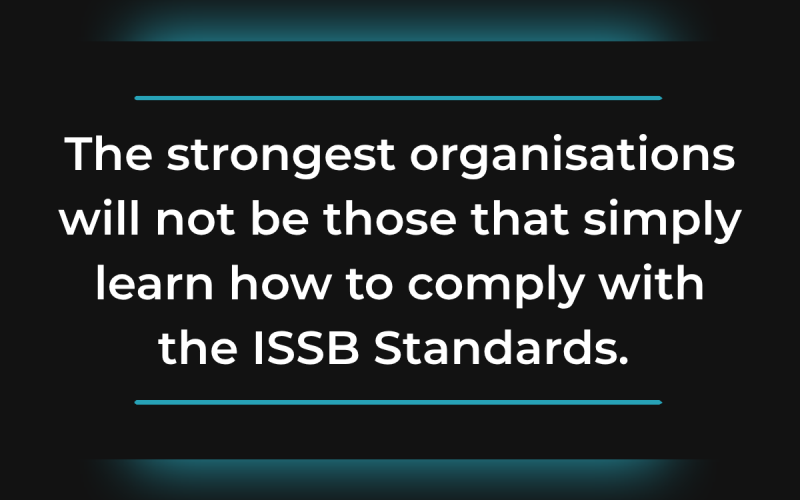
The strongest organisations will not be those that simply learn how to comply with the ISSB Standards. They will be those whose governance evolves quickly enough to support credible, decision-useful disclosure and the business decisions that sit behind it.
That is the real test.
And it will be taken in the boardroom.
The writer is the managing director of CSRWorks International, a sustainability advisory, assurance and training firm.