





Reduced dependence on imported oil and gas has emerged as the primary anticipated benefit of the energy transition across 16 European Union Member States, according to the eighth annual Climate Survey published today by the European Investment Bank (EIB).
The survey, conducted by market research firm Ipsos bva across 23,000 respondents in all 27 EU Member States, highlights shifting priorities driven by ongoing energy cost pressures. Overall, 60 per cent of Europeans report that rising energy prices have significantly eroded their household purchasing power over the past 12 months, with 38 per cent stating they have been forced to cut everyday spending on essential food and health needs.
When evaluating the overall objectives of the energy transition, 82 per cent of respondents highlighted reducing fossil fuel import dependence, 79 per cent cited achieving steadier or lower energy prices, and 76 per cent pointed to slowing climate change. The findings reflect a shift from 2022 survey data, when slowing climate change ranked as the leading expected benefit in 19 Member States, compared to just three today.
Key operational, industrial, and economic findings from the survey include:
- Urgency and risk perception: Three in four Europeans view the energy transition as an urgent national priority. Furthermore, 79 per cent identify rising long-term energy prices as the primary risk of a delayed transition.
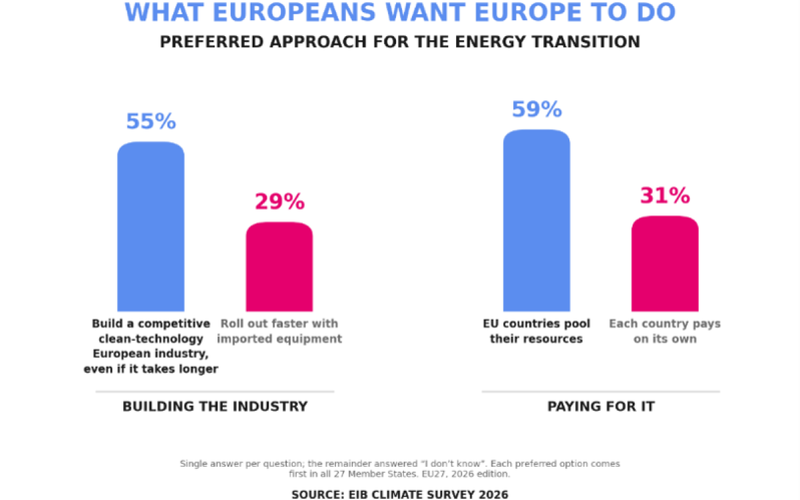
- Domestic clean tech preference: A majority of 55 per cent favor developing a competitive European clean-technology manufacturing sector—even if it extends rollout timelines—over relying on imported equipment.
- Fiscal and regional cooperation: 59 per cent support pooling EU financial resources to fund clean energy infrastructure, while 68 per cent advocate for closer cross-border collaboration.
- Technology focus: Solar energy (52 per cent) and wind power (37 per cent) remain the top prioritized low-carbon technologies across all Member States.
- EIB capital deployment: The EIB Group doubled its annual energy sector financing to €33 billion in 2025 following geopolitical disruptions in Eastern Europe, currently funding roughly 50 per cent of European grid projects and one-third of onshore wind farms.
Nadia Calviño, President of the EIB Group, stated that breaking reliance on imported fossil fuels is both environmentally necessary and economically strategic to lower structural energy costs for households and industrial enterprises across the continent.