

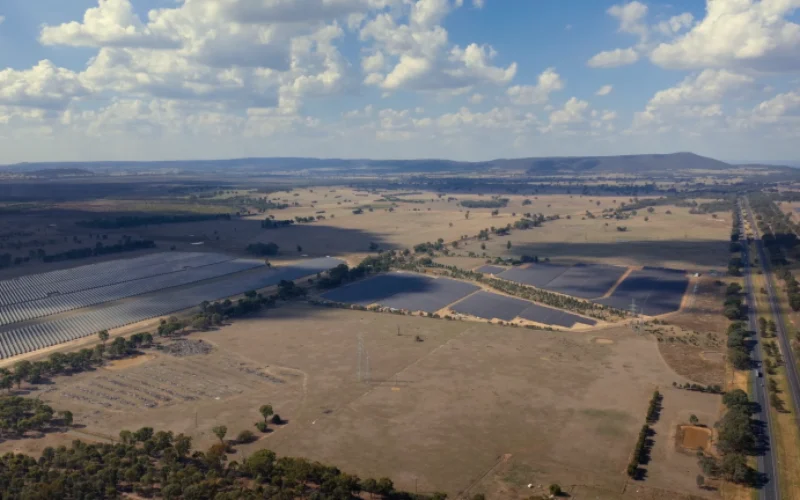
Amazon Australia has announced its largest-ever renewable energy investment in the country, signing nine new power purchase agreements (PPAs) that will add 430 megawatts (MW) of clean energy to the national grid. The expansion brings the company’s total Australian renewable capacity to nearly 1 gigawatt (990MW), sufficient to power the equivalent of more than 500,000 households annually once fully operational.
The new portfolio features a significant shift toward storage technology, with eight of the nine deals incorporating battery energy storage systems. These represent Amazon’s first solar-battery hybrid projects outside the United States. The projects, located across New South Wales and Victoria, include a wind farm, three utility-scale solar hybrids, and several distributed solar-battery installations.
Since 2020, Amazon has invested an estimated AU$2.8 billion in Australian renewable energy. This latest surge in procurement solidifies Amazon’s position as the largest corporate purchaser of carbon-free energy in Australia for 2025, according to BloombergNEF data.
New South Wales Projects
- Muswellbrook: Solar farm with battery storage (OX2), located on rehabilitated former coal mining land.
- Forest Glen: Solar farm with battery storage (X-ELIO).
- Stanbridge: Solar farm with battery storage (Anza).
Victoria Projects
- Golden Plains 2: Wind farm (TagEnergy).
- Laceby: Solar farm with battery storage (Anza).
- Indigo: Solar farm with battery storage (Anza).
- Barnawartha: Solar farm with battery storage (Anza).
- Mooroopna: Solar farm with battery storage (Anza).
- Mokoan: New battery storage installation at the existing Amazon-enabled solar farm (European Energy).
The investment is a critical component of Amazon’s broader strategy to support its expanding digital infrastructure. In June 2025, the company announced an AU$20 billion plan to bolster data centre capacity for cloud and AI technologies. By adding new carbon-free energy to the grid, the firm aims to offset the power requirements of these advanced operations while supporting its goal of reaching net-zero carbon by 2040.