




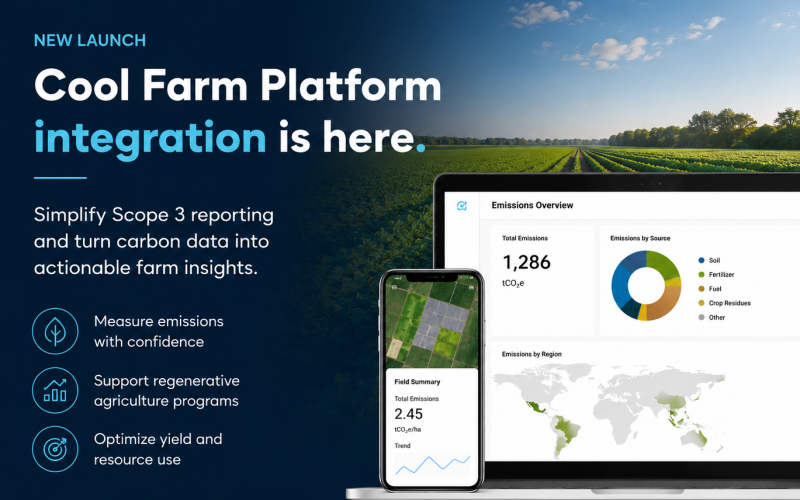
Agtech company CropX has announced the launch of its new Cool Farm Platform (CFP) integration, providing agribusinesses, consumer packaged goods companies, and corporate sustainability teams with an automated framework to manage Scope 3 supply chain emissions tracking.
The development addresses the operational hurdles created by expanding international climate disclosure mandates, which frequently force agricultural supply chains to deal with fragmented field data, manual data entry, and inconsistent carbon accounting metrics. The software integration resolves these friction points by synchronizing carbon accounting, real-time agronomic insights, and sustainability reporting into a unified digital workflow.
As part of the rollout, CropX has secured an official Cool Farm API licence, granting the company direct integration rights to the latest automated calculations and methodologies managed by the Cool Farm Alliance.
The technical architecture provides corporate users with advanced greenhouse gas (GHG) calculation engines, updated global emission factors, and a process-based Soil Organic Carbon (SOC) model engineered to improve the accuracy of soil carbon sequestration tracking. The platform’s analytical dashboards break down emission sources by geographic region, individual grower, and specific crop type, allowing environmental, social, and governance (ESG) directors to execute targeted carbon reduction strategies.
Operating via paired mobile and web interfaces, the system digitizes the end-to-end carbon accounting lifecycle, including field data collection, geographic information system (GIS) mapping, and automated carbon balance simulation scenarios. The software also incorporates commercial agrochemical databases, allowing farm managers to cross-reference chemical applications with operational sustainability targets without disrupting day-to-day cultivation.
Built upon an API-first framework, the integration enables scalable deployment across multinational agricultural programs, offering faster processing speeds and automated data validation. The system is designed to allow commercial agri-food enterprises to scale up their supply chain carbon accounting efficiently without adding administrative burdens for primary producers or corporate ESG auditors.