






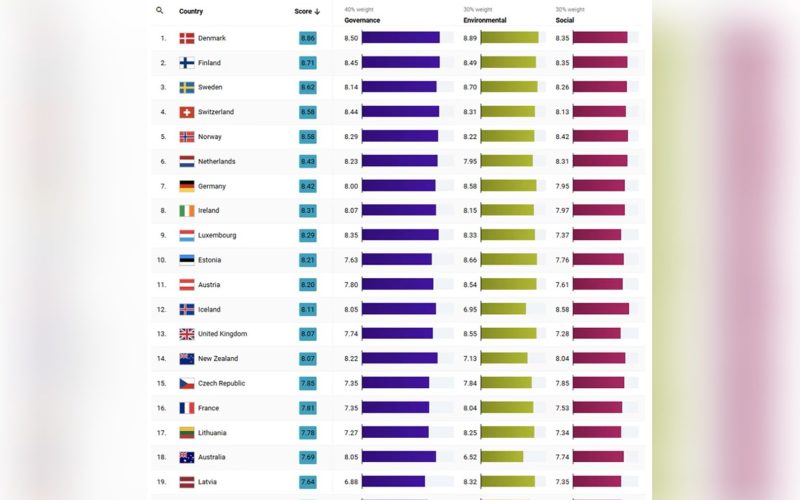
Denmark has secured the top position in asset manager Robeco’s latest Country ESG rankings, marking its fourth consecutive residency at the apex of the sustainability index across a two-year period. Nordic economies continue to populate the upper echelon of the sovereign debt assessment framework, with Sweden, Norway, and Finland—alongside Switzerland—rounding out the global top five slots.
Despite their leading positions, absolute environmental performance among the frontrunners showed signs of stagnation. Denmark and Sweden both experienced a slowdown in the rate of renewable energy integration into their national power mixes, while Norway lost ground due to escalating climate risks and water stress management challenges. Finland emerged as the sole leader to post an environmental score increase, driven by accelerated renewable energy capacity additions and optimized water utilization.
The ESG performance of the world’s largest sovereign debt issuers continues to fragment. Japan’s sustainability score edged downward to 7.46 out of 9.0 due to a contraction in its climate and energy scores. Conversely, the United States maintained a stable rating of 6.61 out of 9.0; a decline in its governance marks—stems from rising corruption indicators and weakened institutional frameworks—was counterbalanced by an uptick in its environmental score. This environmental buffer resulted from the implementation of Liberation Day tariffs, which effectively lowered the embodied carbon dioxide emissions associated with imported consumer goods. China also registered a marginal score expansion, propelled by ecological remediation efforts targeting extinct species and regional biodiversity health.
In emerging markets, Singapore posted the largest absolute score increase on the back of enhanced municipal water management infrastructure. Meanwhile, structural environmental downgrades drove the sharpest score contractions in Botswana, Qatar, Mali, Türkiye, and Hong Kong.
The sovereign index also captured profound geopolitical shifts, notably in Hungary following the abrupt political exit of Viktor Orban and the Fidesz party in early 2026. After nearly two decades of increasingly authoritarian governance, Orban’s administration was unseated by Peter Magyar’s Tisza coalition. While the political transition establishes a positive trajectory for Hungary’s governance profile, Robeco analysts note that systemic anti-corruption and institutional reforms will face delays, as long-dated judicial, media, and banking appointments made under the previous regime remain intact.
In Latin America, Peru’s sustainability profile deteriorated significantly. Long considered a stable regional performer, the country’s social and governance scores have been severely impacted by a chronic leadership crisis featuring multiple presidential successions, cabinet reshuffles, and systemic institutional friction. This political instability has undermined public services, halted poverty reduction initiatives, and compromised environmental enforcement, leading to an increase in illegal mining, deforestation, and water pollution in a region already vulnerable to physical El Niño climate shocks.
Reflecting the systemic fiscal vulnerability of digital dependence, Robeco has formally integrated cybersecurity metrics into its sovereign ESG framework. The methodological update acknowledges that large-scale cyberattacks impose severe direct and indirect fiscal burdens on state budgets through emergency response spending, critical infrastructure remediation, litigation, and macroeconomic productivity losses. Historical precedents, such as the USD 10 billion global fallout from the 2017 ‘NotPetya’ attack and the disruption of the UK’s National Health Service by the ‘WannaCry’ ransomware, underscore the material impact of digital security on national resilience.
To quantify this risk, the updated framework incorporates data from the Global Cybersecurity Index (GCI), compiled by the International Telecommunication Union (ITU). The data indicates that robust cyber defense does not strictly correlate with high gross domestic product (GDP). Advanced and emerging economies alike—including Finland, Italy, Egypt, and Indonesia—achieve strong rankings by implementing a centralized, “whole-of-government” approach characterized by dedicated cyber defense agencies, statutory incident-reporting mandates, and international intelligence cooperation.
Conversely, several lower-tier nations have rapidly expanded digital and financial services without a parallel investment in cybersecurity governance, leaving their critical infrastructure exposed to material sovereign risk.