








The European Union’s import tariffs have successfully lowered the overall market share of electric vehicles manufactured in China, according to a fresh analysis by the campaign group Transport & Environment. However, the data reveals a mixed picture. While Western carmakers have responded by moving production lines out of China, imports from domestic Chinese brands have continued to climb. To prevent Europe from becoming a dumping ground or a basic assembly hub, the campaign group has urged Brussels to introduce tougher trade measures, including new tariffs on Chinese batteries.
According to the research, electric cars built in China made up 17% of the EU battery-electric vehicle market in the first quarter of 2026. This is down from a peak of 22% in 2024 when the defensive trade measures were first implemented. The drop was primarily driven by Western automotive giants like Tesla, BMW, and Volvo shifting their supply chains from China back to Europe. Consequently, the share of Chinese electric vehicle imports coming from European manufacturers fell from 38% in 2024 to 23% in early 2026, while Tesla’s portion dropped from 26% to 19%. As a result, Chinese carmakers now command more than half of all electric car imports coming from China.
The analysis shows that Chinese manufacturers adapted quickly to the trade barriers, though differing tariff rates yielded starkly contrasting results. Imports from SAIC, which faces a heavy 35% tariff rate, nearly halved between 2023 and 2025. Conversely, BYD capitalised on a lower 17% tariff rate, more than doubling its shipments into the EU over the same period. Even with the penalties applied, electric vehicles from Chinese brands remain 21% cheaper on average than those manufactured by European companies.
In an effort to bypass the trade barriers, Chinese firms are rapidly localising their production, with ten new factory openings announced since the European Commission launched its anti-subsidy probe in late 2023. Manufacturers have also aggressively pivoted towards plug-in hybrids, which are exempt from the battery-electric vehicle tariffs. This tactical shift has seen Chinese brands capture 13% of the EU plug-in hybrid market, up from just 3% in 2024.
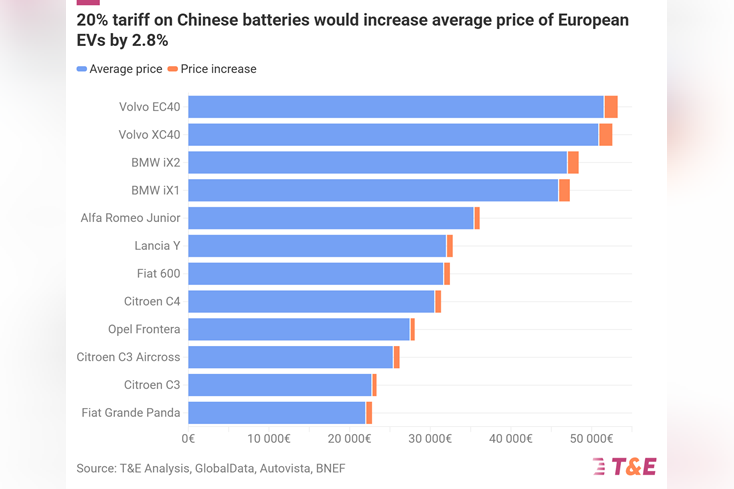
Meanwhile, a massive loophole remains in the battery sector, where imports from China face virtually no trade barriers and have septupled since 2020. European companies currently produce less than a quarter of the batteries utilised within the EU, leaving the future of local manufacturing highly uncertain. Transport & Environment argues that introducing a 20% tariff on Chinese batteries would shield local manufacturers without derailing the electric transition, adding an average of just 2.8% to the cost of a European-made electric car.
The campaign group also warned against watering down the EU’s automotive carbon dioxide targets, noting that weaker proposals championed by some lawmakers could allow European brands to slow down electrification. This delay could result in Chinese brands seizing up to 30% of the market by 2035, compared to just 15% under the original European Commission plans.
Lucien Mathieu, Cars Director at Transport & Environment, stated that whilst the tariffs have worked to a certain degree by prompting Western brands to relocate and Chinese firms to onshore, European competitiveness remains under threat. He emphasised that while carbon dioxide standards are crucial to building the domestic market, a robust local battery supply chain will require a strategic mix of incentives and firm protection.