






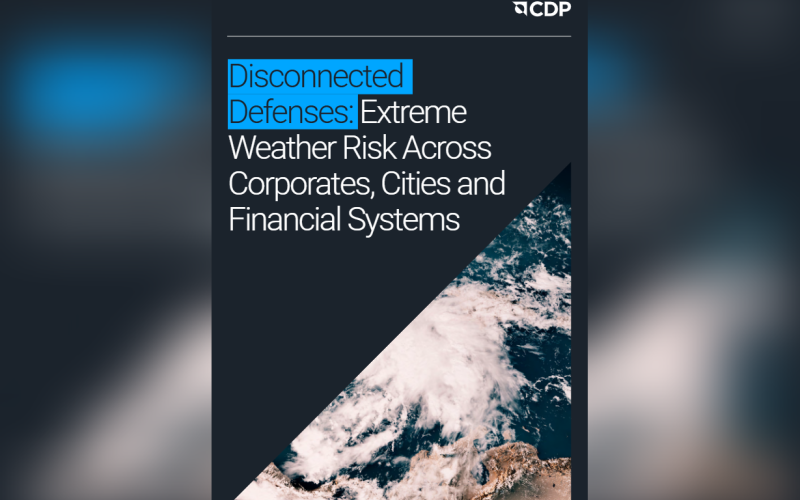
Extreme weather has moved from a future threat to a present-day financial burden, according to new data from CDP, the world’s leading environmental disclosure system. Analysis of 2025 disclosures reveals that while only 35% of companies currently identify extreme weather as a “material risk,” the global economy has already suffered nearly $3 billion in direct losses over the past year.
The report highlights a significant “perception gap” in the private sector, as the anticipated future financial impact of these risks has surged to nearly $900 billion.
Of the losses reported in 2025, heavy rainfall emerged as the most destructive factor, accounting for $1.5 billion in damages. These costs were primarily driven by increased direct operational expenses ($309 million) and forced shutdowns ($266 million).
The outlook for the coming years is even more severe. Disclosing companies anticipate a total of $898 billion in future financial impacts. The primary drivers include:
- Flooding: Estimated $528 billion impact.
- Cyclones: Estimated $161 billion impact.
- Heavy Rain: Estimated $86 billion impact.
Alarmingly, 48% of these risks are expected to materialise within the next 24 months, placing them well within the current business planning cycle.
The CDP report, titled 2025 Disclosure Dividend, offers a silver lining: the cost of action is significantly lower than the cost of inaction. The median cost of climate risk per company stands at $39.4 million, whereas the median cost to mitigate those same risks is just $3.1 million—nearly 13 times less expensive.
“Extreme weather is already a financial risk. It has a dangerous domino effect,” said Amir Sokolowski, Global Director of Climate at CDP. “Our report highlights that efforts to address this risk are not sufficiently coordinated, and those gaps in collaboration are a significant risk in their own right.”
The crisis extends to subnational governments, with 62% of the 1,005 cities and regions reporting to CDP stating they are already significantly impacted by extreme weather. Extreme heat, urban flooding, and drought are the most frequently cited hazards.
While cities are moving beyond pledges to design concrete infrastructure projects, they face a massive investment gap of at least $34 billion. Nearly half of reporting subnational governments cited budget constraints as the primary barrier to effective climate adaptation.
CDP is advocating for a “whole-of-economy” approach to risk management, moving away from viewing climate change as an isolated asset-level issue. The organisation’s recommendations include:
- For companies: Treat extreme weather as a systemic risk, recognising dependence on shared infrastructure and logistics networks.
- For subnational governments: Use public disclosure to map where infrastructure and hazard exposure intersect to unlock private investment.
- For regulators: Use supervisory tools to address systemic financial risks, such as uninsured physical assets.
The report concludes that by aligning investment and strengthening shared systems, both businesses and governments can reduce vulnerability and accelerate the transition toward a more resilient global economy.