





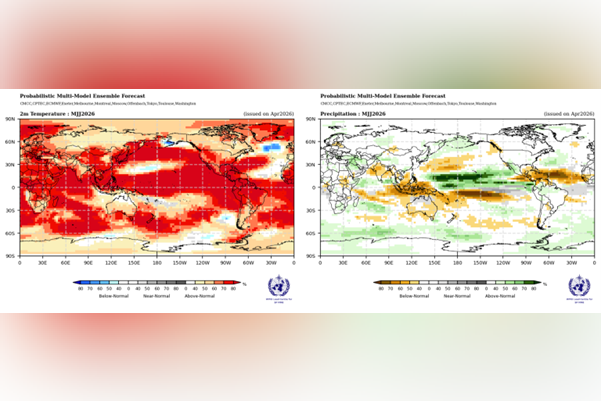
The World Meteorological Organization (WMO) has issued a significant climate update, warning that an El Niño event is expected to emerge from mid-2026. This major climate shift is predicted to alter global temperature and rainfall patterns, with sea-surface temperatures in the Equatorial Pacific already rising rapidly.
Current forecasts indicate a “nearly global dominance of above-normal land surface temperatures” for the upcoming May to July period. While the early months of the year remained in a neutral phase following the end of the 2025–26 La Niña, climate models are now strongly aligned, pointing toward a likely return of El Niño conditions as early as May–July 2026.
“After a period of neutral conditions at the start of the year, climate models are now strongly aligned, and there is high confidence in the onset of El Niño, followed by further intensification in the months that follow,” stated Wilfran Moufouma Okia, Chief of Climate Prediction at the WMO.
El Niño is defined by the warming of ocean surface temperatures in the central and eastern Equatorial Pacific, typically occurring every two to seven years. While current models suggest this could be a “strong event,” Mr Okia cautioned that the “spring predictability barrier” still poses a challenge for absolute certainty. Forecast confidence is expected to improve significantly after April.
The WMO clarified that it does not use the non-standardized term “super El Niño,” sticking instead to operational classifications. Despite this, the stakes remain high for governments, humanitarian organizations, and the agricultural sector, all of whom rely on accurate forecasts to manage risks associated with drought and flooding.
Historically, El Niño events have a warming effect on the global climate. The combination of human-induced climate change and a powerful El Niño led to 2024 being the hottest year on record. While there is currently no evidence that climate change increases the frequency of these events, experts warn it can amplify their impacts. A warmer atmosphere increases the moisture and energy available, potentially leading to more extreme heatwaves and heavy rainfall.
Each event is unique, but typical associations include:
- Increased rainfall: Likely in parts of the southern United States, southern South America, the Horn of Africa, and Central Asia.
- Drought conditions: Typically observed over Australia, Indonesia, and parts of southern Asia.
- Cyclonic activity: During the Boreal summer, El Niño can fuel hurricanes in the central and eastern Pacific while simultaneously hindering formation in the Atlantic Basin.
Regional outlook and preparedness
The WMO’s latest Global Seasonal Climate Update suggests land surface temperatures will be above normal nearly everywhere this season. This signal is particularly intense for southern North America, Central America, the Caribbean, Europe, and Northern Africa.
To ensure early action, the WMO will issue a more robust update in late May. Meanwhile, regional forums are preparing their own assessments; the South Asian Climate Outlook Forum is scheduled to release its southwest monsoon forecast on 28 April.
Through the WMO Coordination Mechanism (WCM), the organization is providing tailored briefings to United Nations and humanitarian partners. A Global Seasonal Climate Outlook Briefing is set for 29 April to help these agencies prepare for the potential disruptions to water resources, energy, and health sectors.
Technical background
As of April 2026, major monitoring centres—including BOM, JMA, and NOAA—report that the ENSO system remains in a neutral phase. However, observations of increasing subsurface heat content in the equatorial Pacific serve as a key precursor for the projected El Niño development. Most dynamical and statistical models suggest that while neutral conditions persist through the boreal spring, El Niño thresholds may be met as early as the May–July period, potentially lasting through the end of the year.