








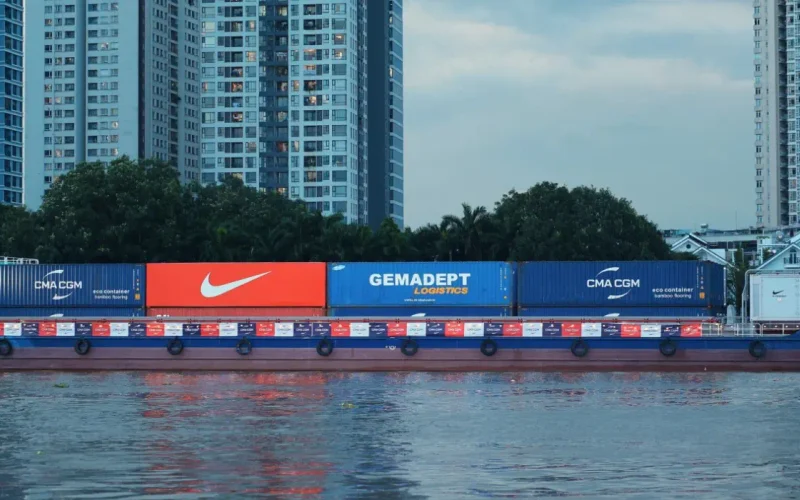
Global shipping operator CMA CGM, sportswear manufacturer Nike, and Vietnamese port operator Gemadept have officially launched a fully electric barge service in Vietnam, establishing a zero-emission inland waterway link to decarbonise local supply chains.
The 100 per cent electric barge operates over a 180-kilometre round-trip route connecting Nike’s inland logistics centre in Ho Chi Minh City with Gemadept’s Gemalink deep-sea terminal in Cai Mep. Recharged using certified renewable electricity sourced from an on-site solar farm at Gemalink, the barge is expected to eliminate approximately 778 tons of carbon dioxide emissions annually. Designed to transport over 50,000 TEUs (twenty-foot equivalent units) each year, the vessel offers a low-carbon alternative to traditional diesel road transport for containerised cargo.
Engineered by CMA CGM’s internal research and development teams, the barge incorporates battery technology supplied by CATL and features a four-hour rapid-charging capability. The integrated system combines battery-electric river transport, dedicated terminal charging infrastructure, and local solar generation, creating a closed-loop renewable logistics model designed for replication across other regional markets.
Key operational, environmental, and corporate components of the initiative include:
- Inland logistics route: Establishes a zero-emission water corridor over 180 kilometres between Ho Chi Minh City manufacturing hubs and Cai Mep deep-sea port terminals.
- Infrastructure integration: Couples vessel battery technology with dedicated fast-charging infrastructure powered directly by Gemalink’s terminal solar array.
- Volume and emission savings: Replaces high-emission road trucking for over 50,000 TEUs of freight annually, yielding 778 tons of direct annual carbon dioxide reductions.
- Partnership ecosystem: Combines CMA CGM’s maritime assets, Gemadept’s terminal infrastructure, and Nike’s corporate off-take demand to scale commercial electric river transport.
Christine Cabau, Executive Vice President of Assets and Operations at CMA CGM, stated that deploying operational electric barges demonstrates that commercial low-carbon inland transport is achievable when ocean carriers, cargo owners, and port operators pool capital and technical expertise.
Cimarron Nix, Chief Sustainability Officer at NIKE, Inc., noted that scaling supply chain decarbonisation requires cross-sector partnerships capable of converting technical innovation into practical operational solutions.
Do Cong Khanh, Deputy Chief Executive Officer of Gemadept Corporation and Chairman of Gemalink Deep-Sea Port, added that integrating clean power generation, charging hubs, and electric vessels establishes a practical template for transitioning Vietnam’s broader port and river transport networks towards low-carbon operations.