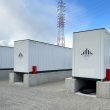



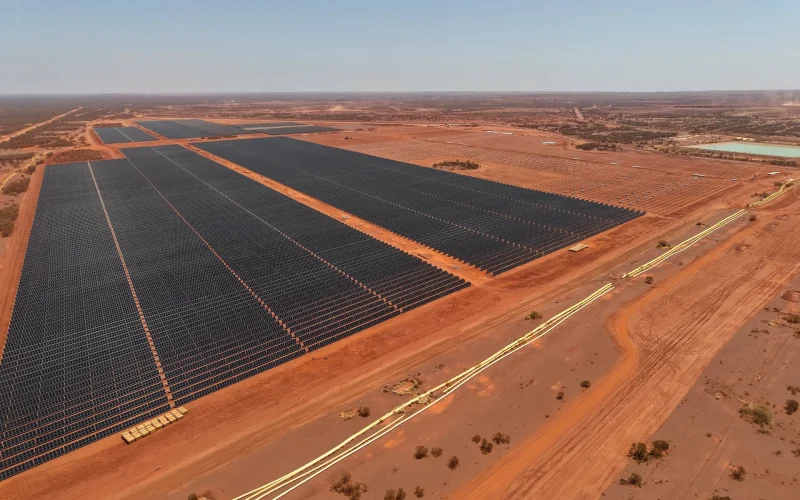
Fortescue has broken ground on its 690MW Turner River solar farm in the Pilbara region, marking the final solar asset needed to satisfy the generation requirements of the company’s “Real Zero” terrestrial decarbonisation strategy. Concurrently, construction has commenced on a 650MWh battery energy storage system (BESS) at its Cloudbreak mining site.
The two developments form part of the Pilbara Green Grid, Fortescue’s expanding integrated power network designed to transition its remote iron ore operations entirely to renewable energy. Once Turner River is complete, its capacity will combine with the company’s existing solar infrastructure—including Solomon Airport (440MW), Cloudbreak (190MW), and North Star Junction (100MW)—to push Fortescue’s total solar portfolio past 1.4GW of generation capacity.
The Turner River project will require the installation of over one million solar panels, with full commissioning anticipated by 2028. The 650MWh Cloudbreak BESS, consisting of 124 modular battery units integrated directly into the site’s existing solar field, is scheduled for completion in the 2027 financial year to deliver 74MW of firm power for up to eight hours. The infrastructure build follows the successful commissioning of two separate battery units at Eliwana and North Star Junction.
To leverage this generation capacity, Fortescue is accelerating the electrification of its mobile mining fleet. The company currently operates 16 electric excavators and an electric drill across its iron ore operations, with half of its excavator fleet projected to be electrified by the end of 2026.
Furthermore, the company’s initial battery-electric haul truck is scheduled to begin site operations later this year, supported by an in-house developed 6MW fast charger capable of replenishing a haul truck’s battery in roughly 30 minutes. In tandem, facility testing for a prototype fleet of battery-electric loaders, dozers, graders, and water carts developed by XCMG is entering final stages in China ahead of site deployment in Western Australia.
Dino Otranto, Chief Executive Officer of Fortescue Metals and Operations, highlighted the pace of deployment, stating: “While others are still debating whether decarbonisation is possible, Fortescue is getting on with building what’s needed to do it. The technology is here. The economics are improving every year. And anyone watching global fuel markets can see exactly why electrification and renewable power matter more than ever.”
Otranto added: “Our solar farms, transmission lines, wind generation and batteries are being built right now across the Pilbara. We are moving first because the economics, the technology and the national interest are all pointing in the same direction.”
Complementing the solar and storage assets, construction remains underway on the company’s 133MW Nullagine Wind Farm to further diversify its generation profile. To distribute this power, Fortescue has built more than 480 kilometres of high-voltage transmission lines, with plans to expand the private network beyond 620 kilometres to physically link its renewable energy portfolio directly to its mines, rail network, and port infrastructure.