









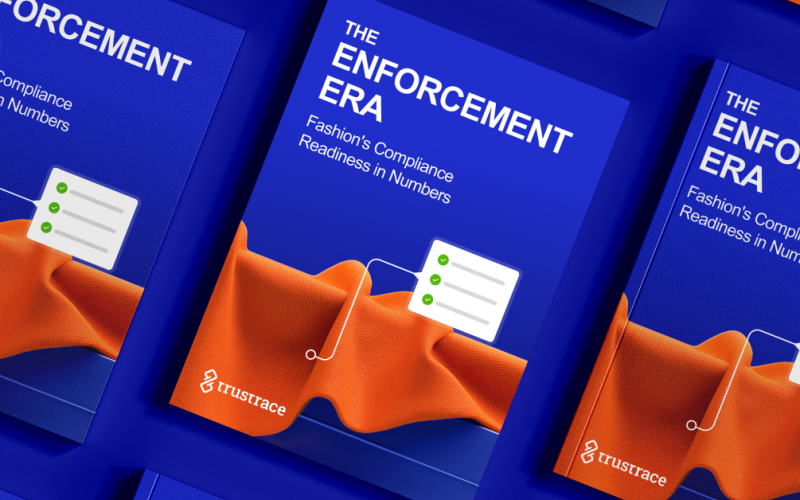
Supply chain traceability firm TrusTrace has published its latest annual industry research report, The Enforcement Era: Fashion’s Compliance Readiness in Numbers, revealing that 75 per cent of surveyed apparel brands cannot fully prove raw material origin on demand.
Launched at the Textile Exchange Conference in Vancouver, the study draws on primary survey data from 57 supply chain, compliance, and sustainability executives across 24 countries.
The findings indicate that regulatory enforcement—including the EU Deforestation Regulation (EUDR), Packaging and Packaging Waste Regulation (PPWR), and US Customs and Border Protection (CBP) forced-labour enforcement—is creating immediate operational and commercial risks for non-compliant brands.
Key findings and supply chain metrics from the report include:
- Active border enforcement: 21 per cent of brands selling into the US market have experienced official shipment detentions by CBP, while 58 per cent of remaining brands view near-term detentions as a realistic commercial risk.
- Upstream visibility gaps: While 75 per cent of brands maintain verified supplier data at Tier 1 (garment assembly), visibility drops to 33 per cent at Tier 3 (yarn and fibre) and 20 per cent at Tier 4 (raw material and farm levels).
- Digital Product Passport (DPP) deficits: 69 per cent of brands are actively preparing for upcoming EU DPP mandates, yet respondents rated their internal supply chain data accuracy at a median score of just 3 out of 5.
- Lagging due diligence: Only 21 per cent of brands operate continuous, automated compliance monitoring across vendor bases, while 48 per cent of US-selling brands have yet to screen suppliers against official government forced-labour entity lists.
- Structural barriers: Limited supplier capability and resistance were identified as the primary operational bottleneck (60 per cent), with 63 per cent calling for standardized, industry-wide supplier data protocols.
Shameek Ghosh, Chief Executive Officer and Co-Founder of TrusTrace, stated that border authorities now require verified evidentiary proof from deep within the supply chain, adding that leading brands are embedding automated compliance into core daily operations.
Tahagod Mohamed, Senior Traceability Analyst at Brooks Running, noted that suppliers face ongoing challenges determining document requirements, recommending comprehensive end-to-end documentation covering raw material harvesting, processing, transport, and commercial transactions.
The report sets out a 90-day compliance strategy for brands, emphasizing tier-mapping baselines, mandatory entity-list screening, and simulated border inquiry stress tests.