



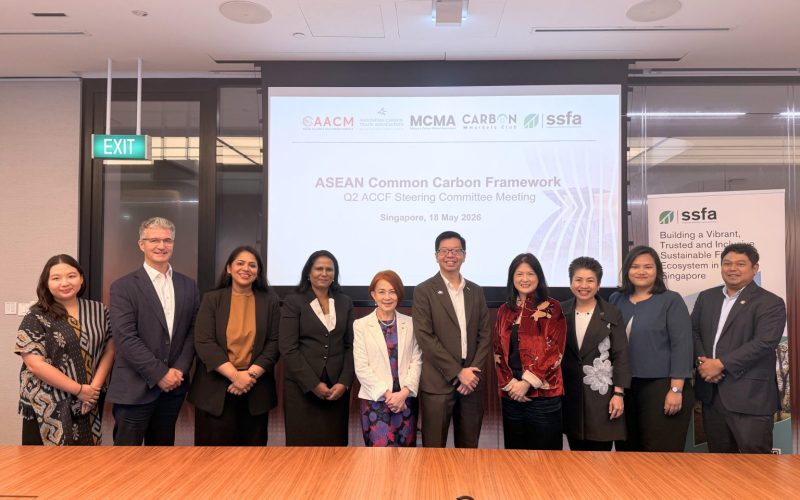
The ASEAN Common Carbon Framework (ACCF) has reported substantial structural progress in harmonising Southeast Asia’s fragmented carbon markets, as regional member associations convened for their Q2 Steering Committee meeting during Ecosperity Week 2026.
The framework has gained significant institutional backing, earning formal recognition from the 57th ASEAN Economic Ministers’ Meeting and the ASEAN Joint Statement on Climate Change to COP30. It has also been integrated into the ASEAN Capital Markets Forum’s official voluntary carbon market guidelines. Over the past year, the ACCF has focused on aligning national and independent carbon accounting standards across the trade bloc with global benchmarks, including the Integrity Council for the Voluntary Carbon Market (ICVCM) and CORSIA.
The ACCF operates across three primary pillars: supply and demand mapping, market infrastructure, and capacity building. Rather than enforcing a singular, rigid system, the framework is engineered to act as a regional integration layer, allowing diverse domestic regimes to connect efficiently.
Several member nations have introduced major domestic initiatives that directly interface with this regional framework:
- Malaysia: The Malaysia Carbon Market Association (MCMA) supported the launch of the country’s new National Carbon Market Policy in April 2026. The policy formally identifies the ACCF as a critical mechanism for cross-border carbon trading and regional regulatory alignment.
- Singapore: The Singapore Sustainable Finance Association (SSFA) is finalising an ‘Implementation Guide for Corporate Usage of High-Integrity Carbon Credits’. This guide builds upon the cross-agency VCM Guidance published by Singapore’s National Climate Change Secretariat (NCCS), Ministry of Trade and Industry (MTI), and Enterprise Singapore in October 2025, providing a blueprint for corporate offset procurement across the broader ASEAN territory.
- Indonesia: The Indonesia Carbon Trade Association (IDCTA) is spearheading technical feasibility studies regarding transition credits aimed at funding the early retirement of coal-fired power plants, alongside establishing regulatory infrastructure for regional carbon capture and storage (CCS) pipelines.
- Thailand: The Thailand Carbon Markets Club (TCMC) secured early cross-border market connectivity by facilitating the first international listing of Thai Renewable Energy Certificates (RECs) and T-VER carbon credits on the Macao Emission Exchange (MEX).
To resolve long-standing data transparency hurdles across South-East Asian jurisdictions, the ASEAN Alliance on Carbon Markets (AACM), in partnership with Fairatmos, has deployed a regional database of carbon project methodologies. This repository allows developers and sovereign buyers to assess and compare crediting schemes across different national jurisdictions, significantly lowering the transaction costs associated with cross-border trading.
Concurrently, the IDCTA, MCMA, and SSFA have formally ratified the Shared Principles under the global Coalition to Grow Carbon Markets to reassure international institutional investors of the environmental integrity of ASEAN-origin assets.
To sustain long-term momentum, the ACCF operates under a rotating organizational leadership structure. The Singapore meeting marked a significant administrative transition, with the MCMA officially handing over the ACCF Chairmanship to the SSFA, effective for the second half of this year.
Under the incoming Singaporean leadership, the ACCF intends to prioritize executing pilot cross-border transactions, expanding institutional capacity building, and broadening stakeholder engagement to incorporate additional ASEAN member states into the carbon trading network.