











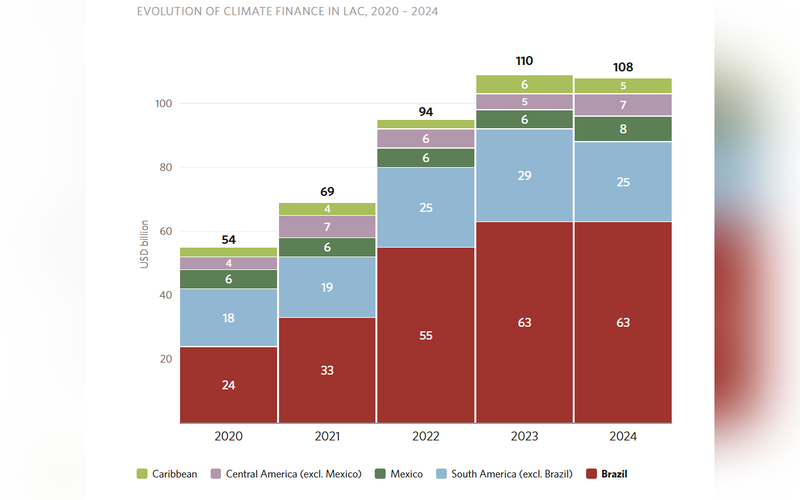
Annual climate finance flowing to Latin America and the Caribbean (LAC) doubled from $54 billion in 2020 to $108 billion in 2024, according to new research published by the Climate Policy Initiative (CPI).
However, the report (The Landscape of Climate Finance in Latin America and the Caribbean) reveals that overall financial flows remained flat compared with 2023, when investment reached $110 billion. Furthermore, fossil fuel investments in the region totalled $95 billion in 2024—more than double the $43 billion in tracked climate finance allocated specifically to energy systems.
The findings highlight substantial funding shortfalls across critical sectors when evaluated against estimated mitigation requirements through 2030:
- Industry: Currently receives approximately 26 times less climate finance than required.
- Transport: Receives 25 times less than estimated needs.
- Agriculture, Forestry, and Other Land Use (AFOLU): Faces a regional gap seven times below required levels. Excluding Brazil, the shortfall expands to 125 times below estimated needs, despite the sector generating 54 per cent of LAC’s greenhouse gas emissions.
Barbara Buchner, Chief Executive Officer of the Climate Policy Initiative, stated that while climate finance has expanded, the immediate priority is directing capital toward bankable opportunities across energy, transport, agriculture, and nature that deliver both economic and climate benefits.
The report notes that domestic sources provided 69 per cent of tracked climate finance in 2023/24. Domestic funding was particularly dominant in Brazil, which accounted for 58 per cent of total regional climate finance in 2024, with local actors supplying 90 per cent of those funds. Similarly, domestic capital accounted for 64 per cent of climate finance in Mexico.
Conversely, private capital remains heavily concentrated in mature markets. Outside Brazil, Mexico, and Chile, public institutions provided between 60 per cent and 84 per cent of total climate finance during 2023/24, underscoring the ongoing requirement for public de-risking mechanisms.
Adaptation initiatives remain underfunded across the region, securing $12.5 billion in 2024—representing 11 per cent of total climate finance—compared with $85 billion allocated to mitigation efforts.
To address these investment gaps, CPI outlined five priority recommendations: aligning national budgets with transition roadmaps, deploying risk-mitigation tools to crowd in private capital, integrating physical climate risk into asset valuation, scaling investments in renewable energy and green value chains, and strengthening regional data systems and institutional capacity.