










Energy company Uniper and renewable fuel developer Arcadia eFuels have signed one of Europe’s largest sustainable aviation fuel (eSAF) offtake agreements to date, supporting the development of production capacity within the European Union.
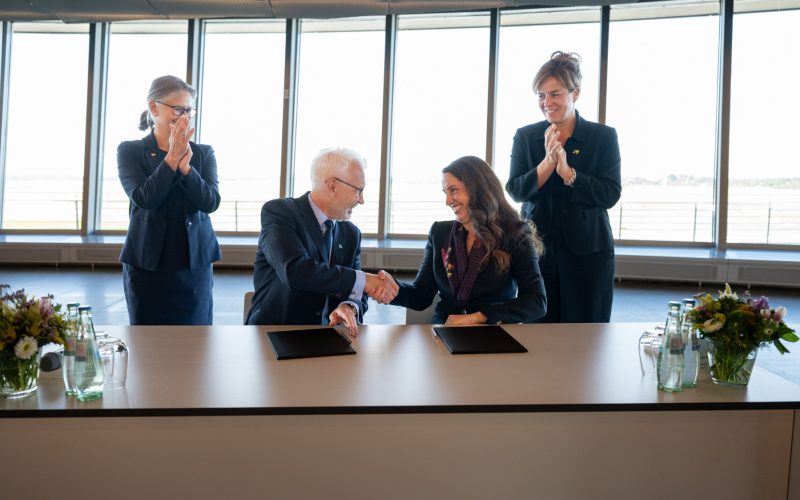
The legally binding agreement was signed in Düsseldorf, Germany, in the presence of Mona Neubaur, Minister for Economic Affairs, Industry, Climate Action and Energy of the State of North Rhine-Westphalia, alongside Anette Galskjøt, Consul General of Denmark in Hamburg.
Under the terms of the agreement, Uniper will purchase 40,000 metric tonnes of synthetic eSAF annually from Arcadia’s flagship facility, Project Endor, located in Vordingborg, Denmark. Deliveries are scheduled to commence in the early 2030s, subject to the facility reaching commercial operations and meeting specified conditions precedent.
The contracted annual volume is equivalent to the fuel required for approximately 1,000 transatlantic flights between Düsseldorf and Abu Dhabi on a Boeing 787-9 aircraft.
Arcadia eFuels produces synthetic eSAF by combining renewable electricity, self-produced green hydrogen, and captured carbon dioxide. The resulting power-to-liquid fuel achieves up to a 98 per cent reduction in lifecycle greenhouse gas emissions compared to conventional jet fuel and complies with the European Union’s ReFuelEU Aviation mandate for Renewable Fuels of Non-Biological Origin (RFNBO).
Michael Lewis, Chief Executive Officer of Uniper, stated that securing long-term supply agreements is essential to scaling sustainable aviation fuels from pilot concepts to commercial availability, while establishing an early strategic footprint in a high-growth sector.
Amy Hebert, Chief Executive Officer of Arcadia eFuels, noted that the long-term offtake commitment de-risks the capital strategy for Project Endor, providing the financial certainty needed to accelerate facility construction and commissioning.
Mona Neubaur added that cross-border partnerships between Denmark and Germany provide vital planning certainty for industrial decarbonisation, reinforcing European energy resilience as aviation transitions away from fossil fuels.