











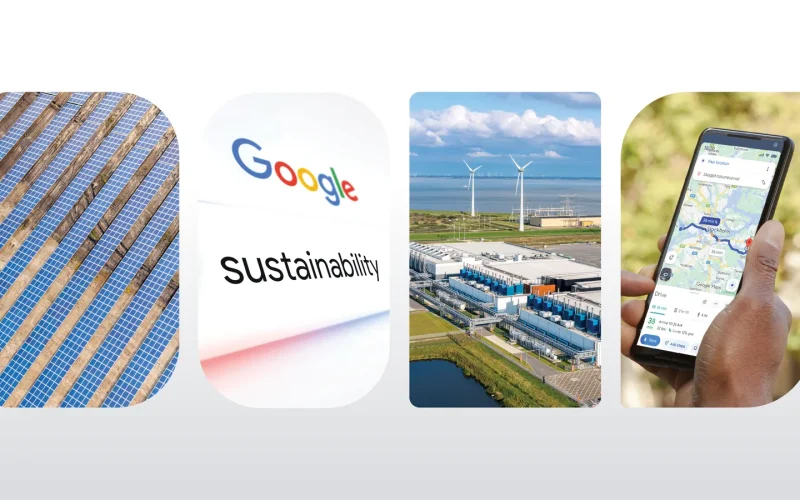
Google has released its eleventh annual Environmental Report, detailing its sustainability performance for 2025 against a backdrop of accelerating artificial intelligence infrastructure expansion.
During 2025, the technology firm signed agreements for more than 12 gigawatts of net-new clean energy capacity. Concurrently, the company recorded a two per cent reduction in its operational emissions, despite experiencing a 37 per cent annual increase in total electricity demand.
Cumulative data from 2010 to 2025 shows the company has secured over 240 agreements, totalling nearly 35 gigawatts of clean energy capacity. The report states that Google matched 100 per cent of its electricity consumption with renewable energy purchases for the ninth consecutive year.
Technological interventions in hardware, software, and compute efficiency reportedly prevented more than 58 million metric tonnes of carbon dioxide equivalent (tCO2e) emissions in 2025. Additionally, the company’s water stewardship projects replenished roughly 7.7 billion gallons of water, accounting for approximately 78 per cent of its annual freshwater consumption.
The publication also highlights the application of artificial intelligence in broader environmental management. In 2025, nine Google AI solutions reportedly assisted external users, cities, and partners in reducing emissions by an estimated 41 million tCO2e.
These applications include solar and wind project site optimisation via Google Earth, automated home energy management through Nest thermostats, and low-emission routing options in Google Maps. The firm is also deploying AI tools for disaster forecasting and wildlife conservation, such as the Perch bioacoustic model and the SpeciesNet wildlife recognition tool.
Despite the reduction in direct operational emissions, Google reported a 25 per cent year-on-year increase in its supply chain emissions. The company attributed this rise to the rapid deployment of AI hardware and infrastructure challenges in the Asia-Pacific region, where supply chains operate on grids facing slow decarbonisation, regulatory barriers, and high construction costs.
The report concludes that infrastructure expansion continues to outpace the rate of global grid decarbonisation.