






Repsol has expanded its low-carbon refining capacity with the launch of its second 100% renewable fuel plant on the Iberian Peninsula, located within its Puertollano industrial complex in Ciudad Real, Spain.
The newly commissioned facility has the capacity to produce 200,000 tons of renewable diesel per year. The output complements the 250,000 tons of renewable fuels produced annually at Repsol’s Cartagena plant, advancing the company’s broader corporate strategy to transform its traditional oil refining assets into circular economy manufacturing hubs.
The project required a €130 million ($140.4 million) investment to execute a first-of-its-kind refinery unit conversion on the Iberian Peninsula, transforming a legacy fossil-fuel processing unit into a facility capable of refining used cooking oil and organic waste derived from the agri-food industry.
The resulting renewable diesel can be deployed immediately within existing automotive, logistics, and maritime refueling infrastructure without requiring mechanical vehicle modifications. Accounting for the full product lifecycle, the facility’s annual output is projected to prevent approximately 700,000 tons of carbon dioxide emissions compared to conventional mineral-based fuels.
Antonio Lorenzo, Director of Repsol’s Industrial Complex in Puertollano, highlighted the regional economic impact, stating: “The start of production at this plant marks another step forward in Repsol’s commitment to liquid fuels from renewable sources, as well as in the transformation of our complex, with the aim of positioning it as a leading industrial hub in the circular economy and renewable fuels. This project is one of the most ambitious undertaken in recent years at the Puertollano industrial complex and demonstrates Repsol’s commitment to industry, the creation of quality jobs, and solutions that help strengthen Spain’s energy independence.”
The engineering and construction phase generated over 650,000 work hours, contracting roughly 80 regional suppliers and sustaining a daily on-site workforce that peaked at over 250 personnel.
To maximize the carbon reduction profile of the finished fuel, Repsol invested an additional €16 million to integrate a renewable hydrogen supply into the hydrotreatment process. The clean hydrogen is synthesized on-site by replacing traditional natural gas feedstocks with waste-derived biogas, allowing the facility to cut the lifecycle CO2 footprint of the manufactured diesel by up to 98 per cent compared to standard mineral diesel.
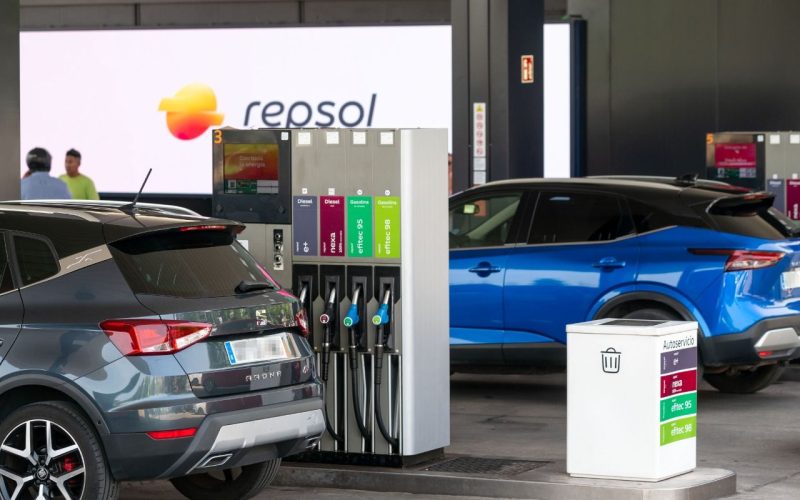
The commissioning aligns with Repsol’s commercial expansion of its premium 100% renewable fuel brand, Nexa Diesel, which is currently distributed across more than 1,600 service stations in Spain and Portugal. The Puertollano site also produces Sustainable Aviation Fuel (SAF) from organic waste for commercial aviation carriers.
Over the past five years, Repsol has directed nearly €800 million toward modernizing the Puertollano complex. Parallel upcoming developments at the site include the imminent commissioning of Spain’s first dedicated ultra-high-molecular-weight polyethylene (UHMWPE) plant to manufacture high-strength industrial superpolymers, alongside existing production lines for chemical recycling, including the Reciclex recycled plastics range and recycled polyol manufactured from polyurethane mattress foam.