


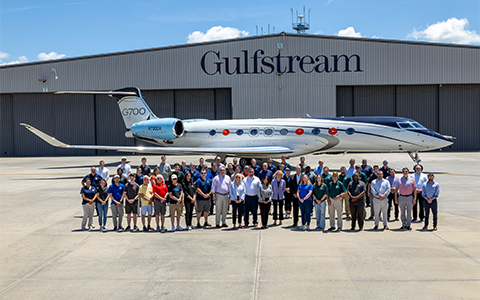
Rolls-Royce has announced that its Pearl 700 engines successfully powered the first flight of the Gulfstream G800 using 100% Sustainable Aviation Fuel (SAF). The flight formed part of a high-altitude test campaign designed to demonstrate how pure SAF can reduce contrail-forming particle emissions at altitudes reaching 50,000 feet.
During the testing, the aircraft flew in close formation with a specially modified Gulfstream G700, which also utilises Pearl 700 engines. The G700 was transformed into a flying emissions laboratory, allowing researchers to capture real-world measurements of particulate matter and atmospheric characteristics at altitudes typical for business aviation but higher than those flown by most commercial airliners.
The campaign was led by Gulfstream Aerospace and conducted alongside a broad coalition of partners, including the Federal Aviation Administration (FAA), NASA, the German Aerospace Center (DLR), and Rolls-Royce. The research aimed to isolate the influence of different fuel compositions on non-carbon dioxide emissions, which are drawing increasing focus across the aerospace industry and scientific community.
Scientists compared the impacts of conventional Jet-A aviation fuel, low-sulphur Jet-A, and pure Hydro-processed Esters and Fatty Acids (HEFA) SAF, which contains zero sulphur or aromatics. Preliminary results from the tests indicate a significant and measurable reduction in the particulate emissions that lead to contrail formation when running exclusively on SAF.
Alan Newby, Director of Research and Technology at Rolls-Royce, stated that sustainable fuels combined with ultra-efficient engines will play a vital role in decarbonising aviation and reducing non-carbon dioxide climate impacts. He added that the insights gained from these high-altitude tests will help drive real progress in understanding and mitigating these environmental effects.
The data gathered will be shared with the broader aviation and atmospheric science communities to refine analytical models, inform future fuel standards, and develop new operational strategies. The tests confirmed that all of Rolls-Royce’s in-production Trent and business aviation engines are capable of operating with 100% SAF. Currently, SAF is only certified for commercial blends of up to 50% with conventional jet fuel. When used in its pure form, SAF has the potential to reduce net lifecycle carbon dioxide emissions by around 80% compared to traditional jet fuel.