






Fusion technology company Thea Energy, Inc. has raised USD 100 million in an oversubscribed Series B financing round. The capital injection will fund the expansion of the firm’s magnet manufacturing infrastructure and fast-track the engineering construction of its integrated stellarator system.
The funding round was led by Thomas Tull’s US Innovative Technology Fund (USIT), alongside a broad syndicate of new institutional backers including General Innovation Capital Partners (GICP), Linse Capital, Calm Ventures, Climate Capital, Divergent Capital, Emerald Technology Ventures, Gaingels, Idemitsu Kosan, Overlay Capital, Timescale Ventures, and Whatif Ventures. Existing investors, including Alumni Ventures, Hitachi Ventures, Lowercarbon Capital, Mercator Partners, Orion Industrial Ventures, Prelude Ventures, and Starlight Ventures, also participated.
Thea Energy develops stellarator-based fusion architecture, an inherently stable magnetic confinement system designed for high-uptime, baseload power generation. Historically, stellarators required highly complex, 3D-shaped magnetic coils that were intensely difficult to manufacture precisely. Thea Energy’s technical framework addresses this limitation by substituting complex physical geometry with modular planar shaping magnets controlled by software-defined engineering systems, shifting complexity from mechanical fabrication to digital controls.
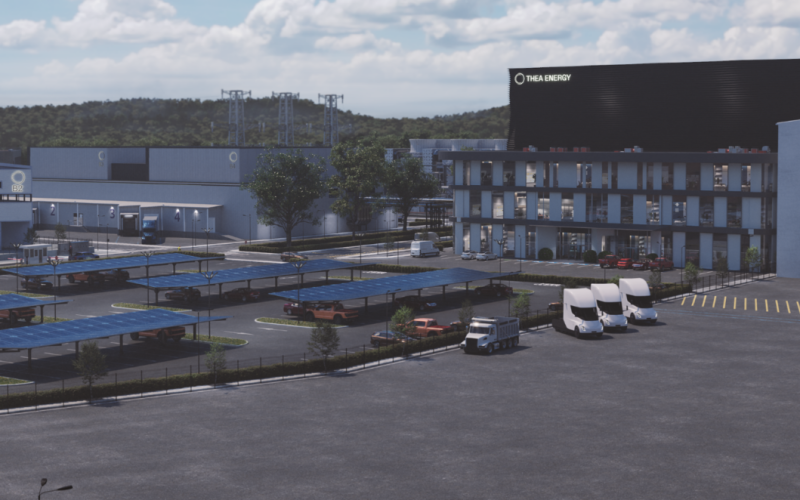
The fresh capital will fund the construction of a second magnet manufacturing facility in Northern New Jersey. Additionally, the funds will support the site selection and engineering design of “Eos,” a large-scale, steady-state integrated stellarator designed to validate the company’s simplified system architecture under power-plant-relevant conditions. The firm plans to finalize the geographic site selection for Eos later this year and intends to double its technical and engineering workforce to support the deployment phase.
The financing follows the US Department of Energy’s (DOE) formal certification of Thea Energy’s “Helios” commercial power plant preconceptual design milestone, making it the first company under the federal milestone-based fusion program to receive the distinction. Over the past 18 months, the company has completed testing of its proprietary superconducting magnet arrays, which are capable of generating the precise magnetic fields required for stellarator operations.
Brian Berzin, Co-Founder and Chief Executive Officer of Thea Energy, highlighted the commercial readiness of the system, stating: “We built Thea Energy to take fusion out of the lab and onto the grid. Our architecture is simpler to manufacture, faster to construct, and more tolerant of real-world conditions compared to all other approaches. Commercial fusion requires adaptable, high-uptime power plants; this Series B accelerates that reality. With the U.S. Department of Energy’s certification of our power plant preconceptual design milestone, proven magnet hardware, best-in-class team, and the capital now in place, we are on the path to delivering the first commercial stellarator power plants.”
Gaetano Crupi, Managing Director at USIT, emphasized the geopolitical and macroeconomic context of the investment, adding: “Thomas Tull has been clear about why he wanted USIT to lead this round: he believes the stellarator is the right architecture for commercial fusion, and Thea Energy is the company that makes it commercially viable. As energy security and rapidly increasing power demands take center stage amidst re-industrialization and the AI boom, the U.S. cannot cede leadership in fusion. Thomas believes this team and their software-based technology are a winning combination.”
The company is working toward starting construction on its first commercial pilot facility, “Helios,” before the end of the decade. Corporate leadership confirmed it is currently engaged in preliminary discussions with over a dozen potential power off-takers, utility operators, and technology hyperscalers looking to secure future baseload power solutions.