










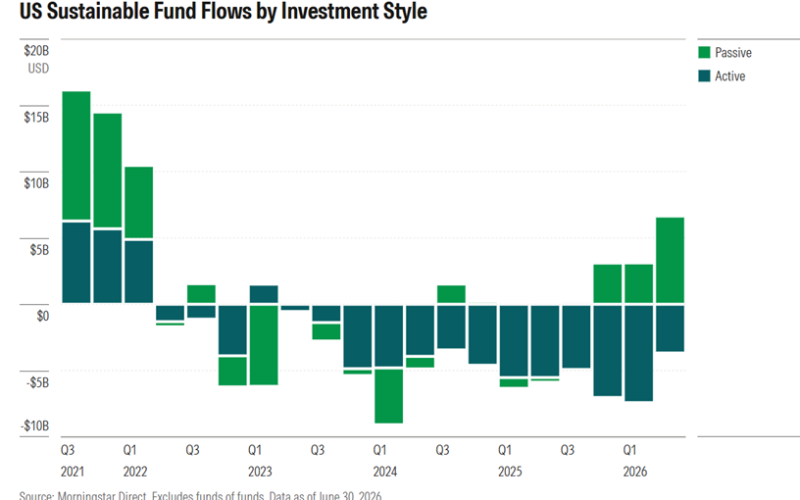
American sustainable funds recorded their first quarter of positive net inflows since early 2022, gathering nearly $3 billion during the second quarter of 2026 and bringing a 14-quarter streak of continuous redemptions to an end, according to a Morningstar report.
Combined with strong market appreciation, the fresh inflows propelled total assets in US sustainable funds to a record high of $398 billion, representing a 13 per cent increase from $351 billion recorded at the end of March.
Despite the turnaround, conventional long-term funds continued to attract substantially stronger demand, collecting $356 billion over the quarter. Sustainable funds registered an organic growth rate of 0.8 per cent, trailing slightly behind the 1.0 per cent growth rate seen across the wider US fund universe.
The sector’s recovery was primarily driven by passive index-tracking strategies, whereas actively managed sustainable funds suffered further losses. Passive strategies secured $6.5 billion during the quarter, easily absorbing the $3.6 billion withdrawn from active options. Active funds have now endured 13 consecutive quarters of net outflows, accelerating a broader industry-wide shift towards lower-cost index products. Passive holdings now account for nearly half of all US sustainable fund assets, with equities continuing to dominate the category at 85 per cent of total assets.
Demand for artificial intelligence infrastructure proved to be a critical catalyst for investor flows. A single fund, the First Trust Nasdaq Clean Edge Smart Grid Infrastructure Index ETF, attracted $3.1 billion in net flows over the quarter. The fund focuses on companies upgrading electrical networks to meet the heavy power demands of data centres alongside variable renewable energy supplies. Top holdings including Eaton and Schneider Electric posted substantial gains during the first half of the year, lifting the fund by 25 per cent and outperforming the broader market.
Energy security considerations also provided a tailwind for returns, as Persian Gulf conflict pushed crude oil above $100 per barrel and encouraged governments to accelerate energy diversification. Renewable energy holdings capitalized on the backdrop, with firms such as Enlight Renewable Energy rising sharply through July.
On the international stage, total global sustainable fund assets reached an estimated record of $3.7 trillion at the end of June, supported by $3.7 billion in global net inflows. However, regional performance remained split. Whilst Europe — which controls more than 80 per cent of global sustainable assets — joined the US in positive territory, outflows continued across Canada, Japan, Australia, New Zealand, and the majority of Asia.