


European aerospace pioneer Airbus has unveiled a comprehensive dual-strategy framework aimed at establishing end-to-end sustainability within the space sector. The engineering initiative marks a major shift towards managing the industrial footprint of spacecraft on Earth while simultaneously rolling out targeted technology to mitigate space debris and minimise the interference of satellite constellations on global astronomy.
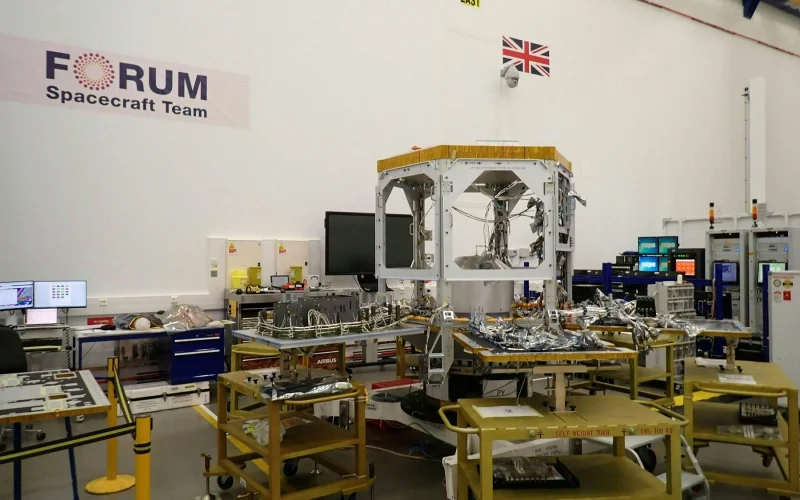
The company is addressing its terrestrial industrial impact by introducing granular Life Cycle Assessment methodologies to map manufacturing and testing activities. Airbus applied this data-mapping approach to the upcoming European Space Agency Earth observation satellite, FORUM, tracking environmental metrics across manufacturing, ground support equipment, transportation, and engineering design offices to isolate environmental hotspots.
To translate high-level ecodesign theory into cleanroom practice, Airbus participated in the ESA GMAIT study, which conducted a dedicated environmental assessment of five essential satellite subsystems: propulsion systems, solar arrays, batteries, heat pipes, and star trackers. Furthermore, in collaboration with Thales Alenia Space, Airbus has co-authored an Ecodesign rulebook for the French space agency, CNES. The rulebook requires engineering teams to embed lifecycle parameters from day one, optimising physical travel, daily lab habits, and supply chain procurement standards.
A parallel arm of the strategy addresses the growing operational density of low Earth orbit. To prevent dead or malfunctioning spacecraft from spinning uncontrollably due to debris impacts or propulsion failures, Airbus has engineered the “Detumbler”. The passive device functions as a magnetic brake, utilizing Earth’s magnetic field to stabilise a tumbling satellite so it remains a clear target for automated capture and de-orbiting missions. A detumbling capability is set to become a mandatory integration requirement for future ESA satellites.
Engineers are also tackling the risk of re-entry debris reaching the ground intact. Under an ESA-funded project, Airbus is designing specialised separable joints using sophisticated software to simulate atmospheric re-entry heat. By integrating 3D-printed internal structures that melt faster than standard solid metals, the company aims to ensure that heavy components, such as titanium optical brackets, break apart and burn up completely in the upper atmosphere.
The final element of the lifecycle framework addresses the impact of expanding satellite fleets on terrestrial astronomy. Working alongside satellite operator Eutelsat and the broader astronomical community, Airbus design teams are developing anti-reflective materials and adjustable solar array angling techniques to eliminate light trails that obscure deep-space observation. The design protocols also impose strict electronic shielding limits to prevent radio frequency leakage from blinding ground-based telescopes, creating a blueprint for quiet and dark orbital infrastructure.