










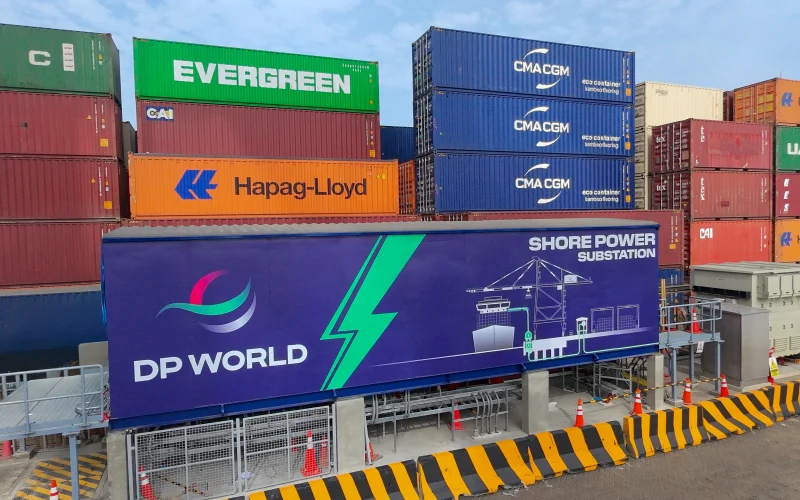
DP World has launched Latin America’s first shore power system at its South Terminal in the Port of Callao, enabling docked container vessels to plug into 100 per cent certified renewable electricity rather than relying on auxiliary engines.
The Onshore Power Supply infrastructure forms part of DP World’s $1 billion investment in Peru and was integrated in to its $400 million Bicentennial Pier expansion. Callao becomes DP World’s third port terminal globally to offer shore power, joining sites in Prince Rupert and Vancouver, Canada, ahead of a planned rollout across European terminals.
The installation is projected to prevent over 6,300 tonnes of carbon dioxide equivalent annually, averaging a 30-tonne reduction per vessel call. While connected, ships are expected to achieve over a 90 per cent drop in fuel consumption alongside reduced emissions of nitrogen oxides, sulfur oxides, and particulate matter. Capable of delivering up to 7.5 MVA, the system can supply power to the largest container vessels operating at Callao under full load.
Approximately 80 per cent of vessels calling at Pier 3 are equipped to utilise shore power, with four of the seven weekly services on the Peru–Asia route expected to connect initially. The 13,100-TEU CMA CGM PLATINUM completed the first connection to the terminal grid.
According to a June 2026 white paper by maritime classification body DNV, only three per cent of ports globally offer shore power infrastructure. The installation addresses vessel emissions at berth, which DP World identified as nearly double those generated by internal terminal operations.
Keiko Fujimori, President of Peru, highlighted the technological milestone: “Today, from here, we are not only moving cargo; we are moving Peru toward the future. We’re talking about a technology that may seem simple but is of enormous importance, since only 3% of the world’s ports have this technology, and we’re proud that Peru is part of this group, serving as an example of environmental protection and modernization.”
Rafael Rey Rey, Peru’s Minister of Transport and Communications, noted: “The shore power system allows compatible ships to connect to the terminal’s electrical grid while docked, so they can shut down their auxiliary engines. This reduces fossil fuel consumption and pollutant emissions, in addition to lowering the noise levels associated with ship operations in port.”
Carlos Merino, Chief Executive Officer of DP World in Peru, Ecuador and Colombia, stated: “Shore power is the next step in our decarbonization journey. We have transformed our own terminal operations through electrification and renewable energy, and now we are extending those benefits to our customers by helping vessels reduce emissions while at berth. This investment strengthens Peru’s competitiveness as a regional trade hub while supporting more sustainable global supply chains.”
The shore power deployment is supported by a broader US$105 million terminal decarbonisation strategy, which includes 36 electric internal transfer vehicles, dedicated electric charging stations, and the conversion of almost the entire yard crane fleet. The combined measures target a 90 per cent reduction in Scope 1 and Scope 2 emissions at Callao by 2030, supporting DP World’s global goal of net-zero emissions by 2050.