









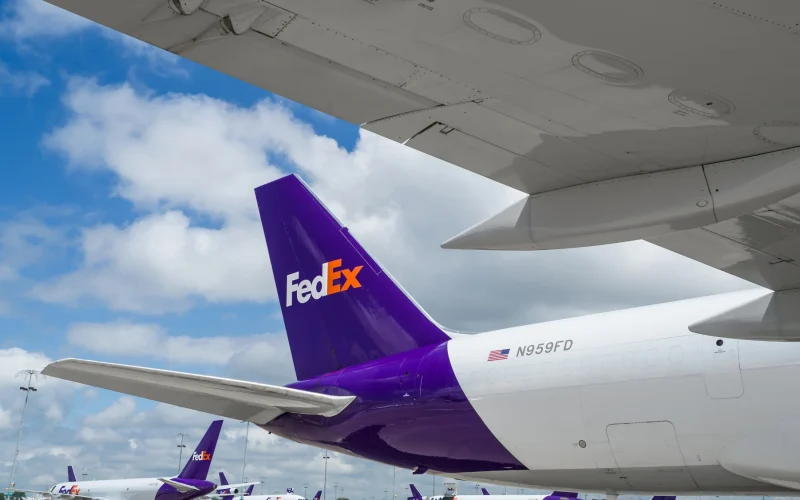
Logistics major FedEx has expanded its sustainable aviation fuel (SAF) procurement, entering into agreements projected to secure more than 20 million gallons of neat SAF across five key United States airport hubs through calendar year 2027.
The agreements cover FedEx flight operations at Newark Liberty International Airport (EWR), Oakland International Airport (OAK), Miami International Airport (MIA), John F. Kennedy International Airport (JFK), and Dallas Fort Worth International Airport (DFW). The delivered SAF will be integrated into operations at blend ratios ranging from 30 per cent to 50 per cent neat SAF, depending on local airport infrastructure.
The procurement builds upon initial agreements initiated in 2025, when FedEx acquired approximately 5 million gallons of neat SAF, resulting in the deployment of 16.5 million gallons of blended fuel across five domestic locations. The expanded volumes support the company’s interim target to source 30 per cent of its total jet fuel requirement from alternative sources by 2030.
Key operational details and procurement metrics include:
- Procurement Volume: Over 20 million gallons of neat SAF secured through calendar year 2027.
- Airport Network Integration: Operational deployment across Newark (EWR), Oakland (OAK), Miami (MIA), New York (JFK), and Dallas Fort Worth (DFW).
- Blending Specifications: On-site delivery blend ratios structured between 30 per cent and 50 per cent neat SAF mixed with conventional jet fuel.
- Policy Incentives: Scaling enabled by state and federal regulatory tax credits and supply-side incentive programs.
Greg Paulus, Vice President of Enterprise Sourcing at FedEx, stated: “The latest agreements represent an expansion of SAF within the FedEx air network enabled, in part, by state and federal level incentives.”
Karen Blanks Ellis, Chief Sustainability Officer and Vice President of Environmental Affairs at FedEx, added: “SAF is one of the most impactful decarbonization solutions available to aviation today and an important part of our approach to reducing emissions. For the market to grow, supply needs to be reliable, affordable, and sustainable. Expanding our procurement allows us to employ more SAF in our network while bolstering the demand for greater production and scale.”